


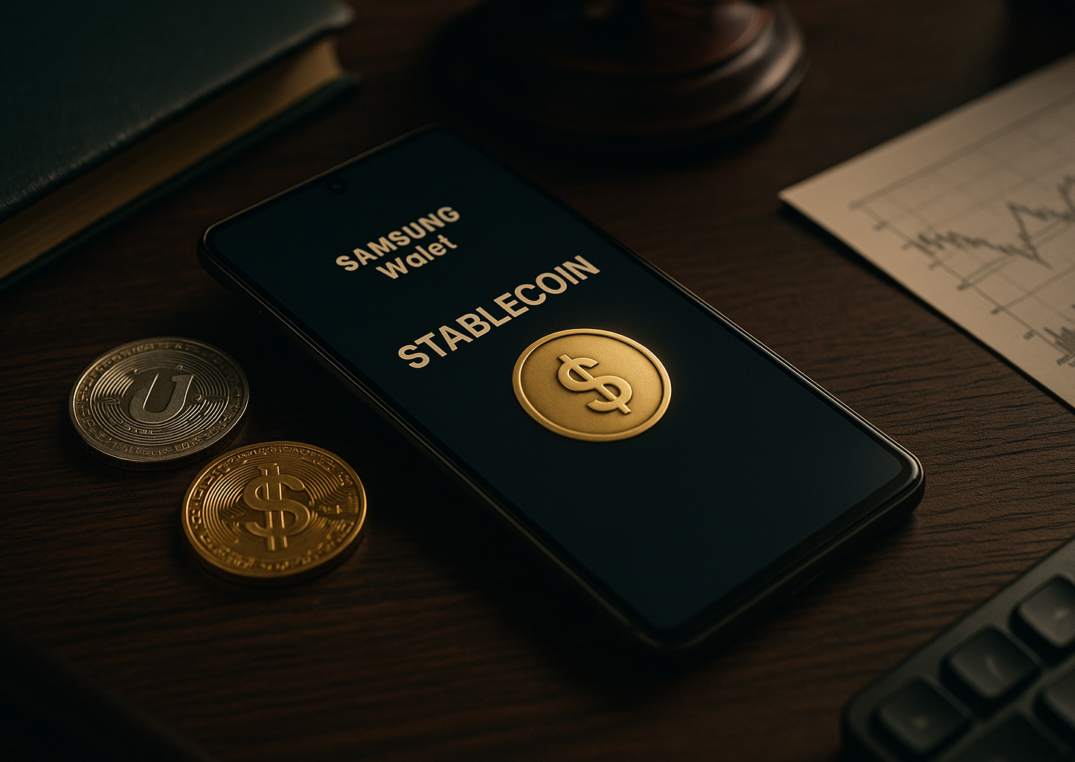
Crypto ETFs: Samsung Wallet’s Stablecoin Plan Sets New Distribution Test as Issuer, Chain and Custody Stay Unnamed
Key Takeaways
- Samsung said Wallet updates “will also support stablecoins” in its Galaxy Unpacked recap, but disclosed no issuer, token, blockchain, custody and redemption model, eligible markets, functions, or launch date; no new dedicated crypto wallet was introduced.
- Product mechanics will determine the distribution effect: a native flow for holding, sending, receiving, or paying could be meaningful, while a funding link or partner account would have a smaller impact; Samsung controls the interface and potential default path.
- Availability and structure will be shaped by regulation (Financial Stability Board recommendations, the U.S. GENIUS Act approved in 2025 with a staged effective date, and the EU’s MiCA) and by network design; the BIS highlights cross‑chain fragmentation and bridge risk.
Samsung’s confirmation that Wallet updates “will also support stablecoins” surfaced in its official Galaxy Unpacked recap, but the company offered no product specification beyond that sentence. For investors in Bitcoin ETF, Ethereum ETF, and broader crypto ETF products, any read‑through for flows, liquidity, or market structure depends entirely on details Samsung has not yet provided: the issuer or token, blockchain, custody and redemption model, eligible markets, supported functions, and launch timing.
ETF Flows and Performance
The announcement contains no data on ETF inflows, outflows, or performance impact. The source establishes only that Samsung intends Wallet to “support stablecoins” without identifying the asset, network, or operational model. Without clarity on whether Wallet will enable a native balance and transactions or merely link out to a partner account, there is no basis to assess implications for primary or secondary‑market flows in crypto ETFs.
The scale of any downstream effect hinges on product mechanics. A native flow that allows holding, sending, receiving, or paying could create a meaningful distribution surface for the selected stablecoin and rails. A funding link, account view, or limited partner integration would extend existing crypto access with a smaller effect on stablecoin payments. Samsung has announced neither version, leaving ETF flow impacts indeterminate.
Assets Under Management
No AUM metrics are provided or implied. Samsung’s frequently cited 800 million user figure refers to the company’s target for devices with Galaxy AI by the end of 2026. The source explicitly notes that this is not an apples‑to‑apples comparison for Samsung Wallet users, stablecoin eligibility, or the number of devices that may receive the feature. As a result, the announcement does not furnish a basis to estimate potential AUM changes for Bitcoin ETF, Ethereum ETF, or multi‑asset crypto ETF products.

Trading Activity and Liquidity
No trading volume or liquidity data accompany the statement. The distribution impact will depend on where stablecoin functions appear in Wallet and how directly a user can access them. If a particular asset becomes the default choice inside a native flow, its issuer could gain visibility through Samsung’s interface. If stablecoin support remains several steps removed via a partner account, the distribution benefit would accrue primarily to that partner. The source does not confirm either model.
Samsung controls the interface, which confers influence over which issuer or network might benefit from default placement. Yet the company has not announced the issuer, chain, custody model, or redemption pathway, and it has not named eligible markets or a launch date. In the absence of those specifics, any effect on intraday liquidity, execution quality, or hedge efficiency for ETF market participants cannot be evaluated.
Institutional Interest
The announcement intersects with policy frameworks that institutional desks track closely. The Financial Stability Board’s stablecoin recommendations emphasize legal claims, timely redemption, and prudential safeguards for covered global arrangements. In the United States, the GENIUS Act, approved in 2025 with a staged effective date, establishes a framework for covered payment stablecoin issuers and custody. Samsung has not said that it will issue, custody, or redeem a token, leaving those obligations unassigned in the current disclosure. In the European Union, the MiCA framework regulates covered crypto‑asset issuers and service providers, which could shape market access.
Design choices will allocate different parts of the Wallet relationship. An issuer selected for default placement could gain direct exposure in Wallet. A chosen network could become the settlement path for supported transfers. Custodians and payment partners could gain the account, redemption, or acceptance relationship. Rival issuers and networks would retain their broader markets but miss Samsung’s default path if the feature launches without them. From an institutional standpoint, that allocation determines who captures the economics and the customer relationship behind the interface.
Impact on Underlying Crypto Market
The network decision is central. The source underscores that stablecoin assets deployed across separate blockchains may not move seamlessly between them, creating fragmented liquidity and reliance on bridges that introduce operational risk, per research from the Bank for International Settlements. A Samsung implementation on a single network would place that network on the default route offered through Wallet. A multichain design could broaden routes while bringing cross‑network frictions into the user experience. A partner‑held balance could conceal the blockchain layer, leaving the partner to manage how value moves behind the interface. Samsung has disclosed no network and no transfer design.
Because the word “support” covers a wide range of possibilities—from a balance redeemed through an issuer or partner, to a transferable token, to a payment function with limited destinations, or simply a route into a third‑party account—the announcement does not establish how on‑device stablecoin activity would interact with exchange, OTC, or custodian rails used in the broader crypto market that underpins ETF pricing.
Broader Context
Samsung Wallet already served as a hub for payments, keys, IDs, boarding passes, and crypto‑related functions before the 2026 roadmap. In July 2025, Samsung announced that Samsung Pay would begin rolling out inside Coinbase as a payment and deposit option in the United States and Canada, and Coinbase published a matching announcement on the same date. That integration connected a familiar Samsung payment method to a separate crypto platform.
The new stablecoin plan, as described in the Unpacked recap, could take Samsung further into the transaction flow—but the disclosure provides no basis to assert that it will. A balance held with a partner, a way to access provider‑managed assets, and a link that only funds another account can all appear inside one interface while distributing control and value to different companies. The 2026 recap names no country, device cohort, or launch sequence for stablecoins.
Jurisdictional rules will shape availability. The FSB recommends that covered stablecoin arrangements meet applicable requirements before operating in a market. The United States has the GENIUS Act framework, while the European Union’s MiCA regulates covered crypto‑asset issuers and service providers. That regulatory fit could produce different products in different places, or a deliberately narrow first release; Samsung has announced neither approach.
What’s Next
The near‑term catalysts are all informational. Samsung has reserved space in Wallet for an undefined stablecoin function and can choose the token, network, and service providers behind that function. Based on the current record, the following remain undisclosed:
- Issuer and token: which stablecoin, if any, will appear by default within Wallet, and under what reserve and redemption terms.
- Custody and redemption: whether balances (if any) are provider‑held, self‑custodial, or funding‑only links; how keys are managed; and how redemptions work.
- Network and transfers: which blockchain will carry the asset; whether there will be single‑ or multi‑chain support; and whether transfers are native or abstracted by a partner.
- Markets and rollout: eligible jurisdictions, device cohorts, and launch sequencing.
- Functions: whether Wallet will enable holding, sending, receiving, paying, or merely provide access to a partner account.
- Timing: a launch date or timeline.
Samsung already owns the front door. The company’s control of the interface means the share of the economic and customer relationship it retains will depend on whether Wallet holds the experience together or primarily hands users to a partner. For Bitcoin ETF, Ethereum ETF, and multi‑asset crypto ETF investors, the investment takeaway today is restraint: without confirmed issuer, chain, custody, markets, functions, or launch timing, there is no evidence to model impacts on ETF flows, AUM, trading volumes, or liquidity. The real prize lies behind the screen—and it will remain unquantified until Samsung fills in the product details it has yet to disclose.
