


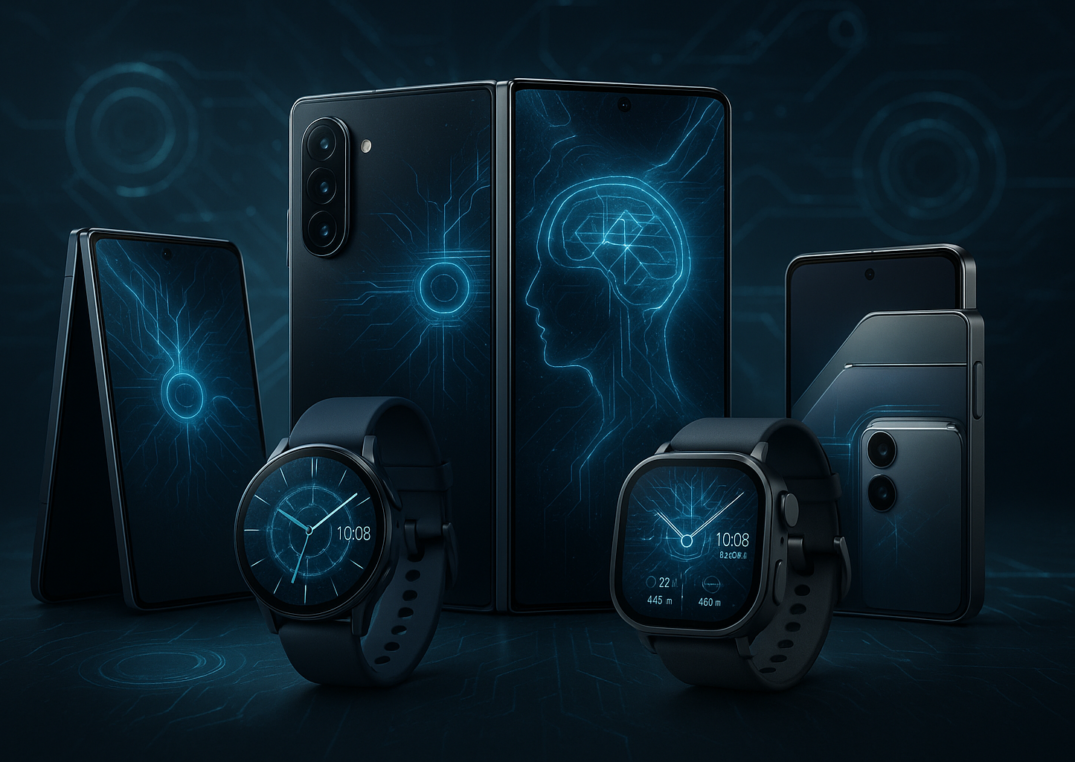
Samsung used its 2026 Galaxy Unpacked event in London to unveil three new foldable phones, two smartwatches, and a teaser for smart glasses, with AI-driven features cutting across the lineup. The company emphasized refinements in display engineering, battery life, and materials while layering in software capabilities such as health monitoring on watches and hands-free assistance via smart glasses. Pre-orders are open now, with devices expected to ship on August 7, 2026.
AI Integration
Artificial intelligence is most explicit on the wearables and glasses. The Galaxy Watch 9 and Galaxy Watch Ultra 2 add AI-powered health features including vitals monitoring, sleep apnea tracking, and hearing insights, plus a new Heart Health score that incorporates blood pressure readings. While not FDA certified or medical grade, these additions are positioned to surface timely, directional insights that users can act on throughout the day. The Ultra 2’s 5,000-nit display, 800mAh battery, and IP69K durability underscore the watch’s role as a persistent companion for data collection and on-wrist analysis.
Samsung’s smart glasses—teased without a release date but potentially arriving this year—demonstrate hands-free AI assistance. During the presentation, the company showed the glasses working with Gemini Intelligence to handle everyday tasks such as booking reservations and ordering coffee. The demo also highlighted integrations across Samsung’s ecosystem: summaries of meetings that can be transferred to Samsung Notes and gesture controls that interoperate with the Galaxy Watch. The promise here is ambient, context-aware computing that shortens routine workflows into quick voice prompts or subtle taps and pinches.
Technology Use Case
Foldables remain the hardware centerpiece, and their form factors support the kinds of multitasking scenarios where AI systems thrive. The Galaxy Z Fold 8 adopts a wider 4:3 inner display and a 10:16 cover screen geared toward messaging and quick actions. Samsung’s “flex titanium” approach—combining a titanium-alloy film with a titanium plate—reduces display crease visibility and improves flexibility, making the unfolded experience more comfortable for extended tasks such as viewing videos or gaming. A 7.6-inch AMOLED panel with 120Hz refresh rate, an anti-reflective coating, and a larger 4,800mAh battery are part of the push toward all-day usability.

The Galaxy Z Fold 8 Ultra scales that blueprint with an 8-inch inner screen and 6.5-inch cover screen, both at 120Hz, while moving to a 5,000mAh battery and up to 45W wired charging. Samsung says the Ultra charges from zero to 67% in 30 minutes, which reinforces the device’s role as a main computing screen that can be topped up quickly between uses. The Ultra also adds camera headroom—a 200MP main, 50MP ultrawide, and 10MP 3x telephoto—as well as 8K video support via the APV codec. Those imaging and video upgrades complement scenarios in which AI-assisted editing, search, and content organization depend on dense, high-quality media inputs.
For users who prefer a pocket-first device, the Galaxy Z Flip 8 introduces a lighter, slimmer flip-style option with a 6.9-inch dynamic AMOLED inner display and a redesigned FlexWindow to surface more apps, notifications, and actions. A 50MP camera pairs with hands-free shooting and stabilization in the Camcorder Grip with Zoom Rocker. Features such as “mirror view” on the cover screen are aimed at quick self-checks and one-handed capture, fitting the flip format’s emphasis on fast interactions. Despite a slightly thicker frame than last year’s model, the Flip 8 is about eight grams lighter at 180 grams, keeps a 4,300mAh battery, and steps up to 45W charging. It runs an upgraded Exynos 2600 with 12GB of RAM and offers 256GB or 512GB of storage in Cream, Graphite, or Pink.
Market Impact
Samsung’s message is twofold: the foldable category is mature enough for broader appeal, and AI functionality is becoming integral to mobile and wearable experiences rather than an add-on. The company’s eight generations of foldables culminate in the first “Ultra” variant and a stronger focus on the crease—long seen as the format’s most visible drawback. At the same time, the lineup arrives amid chatter about a potential foldable iPhone later this fall, sharpening comparisons on design choices, battery longevity, and software experiences. Samsung’s approach leans on differentiated form factors—the Z Fold 8’s passport-style width and the Ultra’s larger canvas—alongside the watches’ health analytics and the glasses’ conversational controls.
The watches reflect a consolidation of features common to top-tier wearables. The Galaxy Watch Ultra 2 adds a brighter screen, a larger battery, and ruggedization, but the notable shift is how health metrics are surfaced. By aggregating vitals into a Heart Health score and extending insights to areas like sleep apnea and hearing, the system encourages daily, incremental engagement. The Galaxy Watch 9 brings a lighter aluminum case, 3,000 nits of brightness, and an upgraded 390mAh battery that Samsung estimates at around 30 hours with the Always-On display active. Those improvements are designed for all-day tracking without frequent charging, a baseline requirement for reliable trend detection.
Industry Response
Early hands-on reactions emphasize build quality and practical refinements. Observers who previewed the Z Fold 8 in London pointed to the reduced crease as Samsung’s best to date, alongside the comfort of the thinner, flatter open position. The Ultra’s brighter panel and anti-reflective coating drew specific attention for video viewing, as did the battery and charging uptick after years of criticism directed at the Fold line’s endurance. On the wearables side, commentary acknowledged that blood pressure readings are not medical grade but suggested that even approximate measurements can provide useful day-to-day context when interpreted with care.
Samsung’s smart glasses attracted interest for their styling—developed with Gentle Monster and Warby Parker—and for the claim of up to nine hours of use per charge. A charging case that can power the glasses up to seven times extends portability. The glasses’ role within Samsung’s broader ecosystem is central: by leaning on existing apps and cross-device gestures, the company is pitching an experience that complements, rather than replaces, the phone and watch. The goal is continuity—moving a summary to Samsung Notes, initiating a task by voice, and confirming an action with a wrist gesture—so that the user can advance simple tasks without reaching for a screen.
What’s New, What’s Not
Across phones, watches, and glasses, the through line is incremental hardware progress paired with AI-enabled software that attempts to make common tasks faster. On the Fold 8 and Fold 8 Ultra, display proportions and coating changes matter because they reduce friction for long sessions, the context in which multitasking and media-heavy workflows occur. The Flip 8 narrows interactions to the essentials through its FlexWindow and camera shortcuts. The watches frame AI as a health companion that nudges rather than diagnoses. And the smart glasses give a view of hands-free assistance that is more tightly integrated into existing apps and devices. Together, the announcements suggest Samsung is positioning its hardware as the scaffold for everyday AI experiences that recede into the background—visible in brief prompts, summaries, and readings—while the device family hands off tasks seamlessly.
