


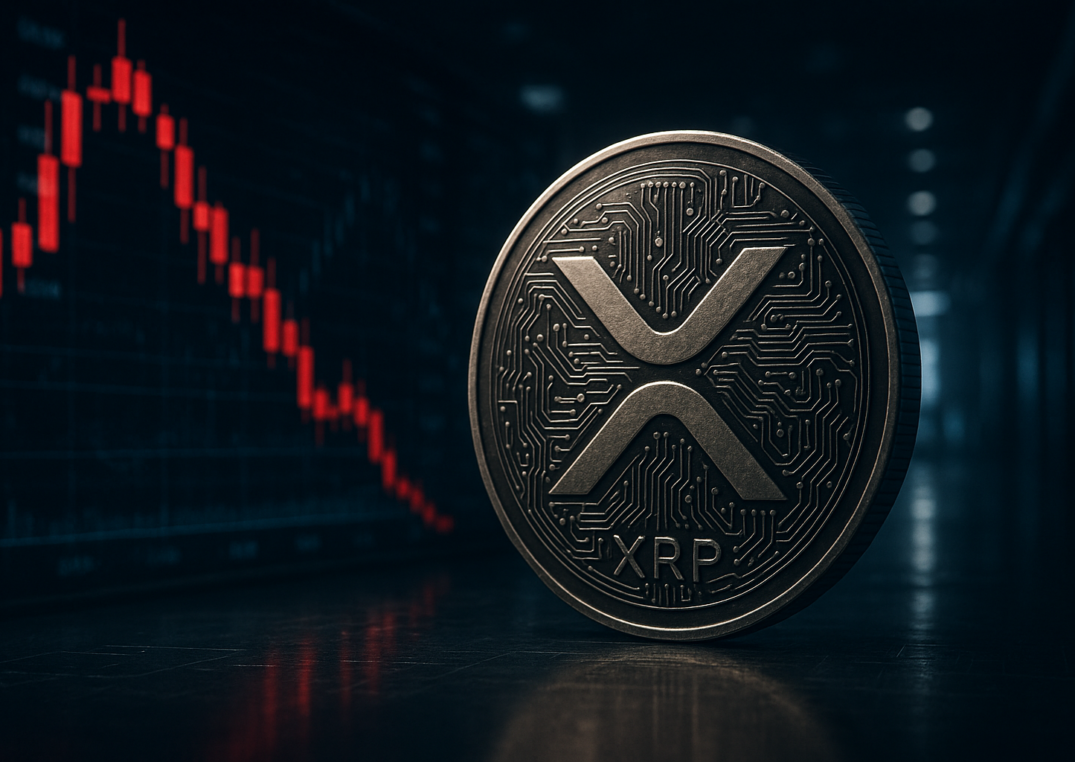
XRP Price Extends 2026 Slide as Bob Loukas Flags Oversold Bounce Risk and Up to 50% More Downside
Meta Description: XRP price weakness deepens in June 2026. Trader Bob Loukas cites oversold signals and warns altcoins, including XRP, may still face up to 50% further declines.
Key Takeaways
- XRP’s losing run has stretched into June 2026, with the token trading near $1.12 amid extreme oversold readings.
- Trader Bob Loukas says a technical rebound is likely but warns XRP and other altcoins could still fall by as much as 50% this year.
- XRP is down about 71% from its 2022–2026 cycle high; RSI divergences suggest seller exhaustion, but any bounce may prove temporary.
XRP extended its 2026 decline into June as selling pressure pushed the token toward deeply oversold territory, drawing a cautionary outlook from trader Bob Loukas. In a post on June 7, 2026, Loukas said conditions are ripe for a technical rebound but warned that XRP—and many altcoins—could still shed up to half their value before the current cycle completes. The debate now centers on whether a near-term bounce can coexist with a still-intact downtrend, and how traders should position for a market that may punish rallies as it searches for a durable bottom.
Market Movement
Monthly return data point to a difficult first half of the year for XRP. The token fell 10.6% in January 2026, slid another 16.2% in February, and, in just the first week of June, was down roughly 15.7%. April offered the only respite, with a modest 2.13% gain. Against that backdrop, Loukas framed the current phase as part of a broader 2022–2026 cycle drawdown in which XRP has retreated about 71% from its cycle high.
That drawdown, he noted, is not out of step with the rest of the market. In his tally, several well-followed altcoins have given up even more ground from their peaks during this cycle. While the magnitudes vary by asset, the pattern he highlights is one of widespread, cycle-level repricing across the altcoin complex. In effect, XRP’s performance, while painful, is neither an outlier nor a clear leader; it is tracking a cohort that has been repriced lower since late last year.

The tape offers little ambiguity about the trend. Momentum has been negative since the end of 2025, following a strong July that delivered roughly a 35% gain and a modest September increase of about 2.49%. The final three months of 2025 then flipped red, setting the tone for 2026’s early sequence of lower highs and lower lows. As of early June, XRP has traded near $1.12, with the price action repeatedly failing to sustain bounces.
Trading Activity
Loukas’s view is that an oversold market does not preclude further declines. It often precedes a countertrend move. On standard technical toolkits, Relative Strength Index readings have started to show bullish divergences—price pushing to fresh local lows while momentum refuses to confirm those lows—conditions that traders interpret as seller fatigue. These divergences, combined with a crowded bearish positioning profile, tend to set the stage for fast, short-lived rallies as shorts cover and sidelined liquidity chases strength.
Past instances lend credence to that setup. After a weak June in 2023, XRP rebounded by about 47.6% in July. In November 2024, following multiple down months, it staged an explosive rally of roughly 281.7%. The problem for bulls is not whether rebounds occur; they often do. It is whether those rebounds can persist long enough to change the intermediate trend. Loukas is skeptical on that front, framing any near-term strength as a pause in a downcycle that still may not have fully exhausted itself.
From a flow perspective, market depth tends to thin out during capitulation phases. That can exaggerate volatility in both directions. On the way down, bids step aside and slippage expands; on the way up, even modest buy pressure can lift price quickly until it encounters stacked offers from holders seeking to exit at better levels. This “liquidity vacuum, then supply wall” dynamic is what often turns relief rallies into distribution zones rather than trend reversals.
Investor Sentiment
Sentiment around XRP reflects the broader risk-off tone in altcoins. Prolonged drawdowns compress risk budgets and shorten time horizons, shifting investor behavior from “buy the dip” to “sell the rip.” As losses accumulate, each bounce is scrutinized as an exit opportunity, particularly by market participants who endured the late-2025 shift into negative momentum. When capital grows more discriminating, rallies must prove staying power with follow-through rather than single-session spurts to overcome entrenched skepticism.
Loukas’s warning of up to 50% additional downside for some altcoins this year underscores that shift in psychology. In that framework, traders fade strength until the market forces them to reassess—typically after a base-building period or a break of key higher-timeframe structures. The suggestion that large players may “sell into strength” is a reminder that positioning by long-horizon holders can become a headwind during relief moves, mopping up liquidity and capping rallies even when intraday momentum looks constructive.
Broader Market Context
The 2022–2026 window has shaped up as a full-cycle environment for digital assets. By Loukas’s assessment, weakness on Bitcoin’s weekly timeframes has weighed on the broader structure. For altcoins, historical beta cuts both ways—outperformance in uptrends and underperformance in drawdowns. If the anchor asset’s higher-timeframe trend is still soft, altcoins usually struggle to reclaim sustained leadership, particularly after steep declines that leave technical overhead at multiple levels.
The second-order effects from 2025’s year-end weakness are still filtering through. After a powerful July that lifted sentiment, the subsequent red months into year-end signaled that trend repair had stalled. When a market fails to hold breakouts and rolls over at quarter-end, the next calendar year often begins with defensive positioning, tighter risk limits and reduced appetite for narrative-driven risk. That has been visible in 2026’s monthly path for XRP—few consolidation phases, sharp legs lower, and brief interludes of stability that fade before resolving higher.
One reason countertrend rallies can still be violent at this stage is positioning asymmetry. As systematic and discretionary sellers dominate for months, marginal buyers retreat. When a catalyst appears—be it technical exhaustion or a short-covering trigger—the market often leaps toward the nearest pockets of liquidity. Yet without a structural shift in demand, those rallies confront an overhang: holders seeking to trim exposure, algorithms programmed to sell into strength, and latent supply clustered near prior breakdown levels.
Industry Impact
Extended drawdowns have consequences beyond price charts. In every crypto cycle, repricing phases pressure speculative capital, reduce turnover, and prompt reassessments of project timelines across ecosystems. For XRP, which sits at the intersection of payments-focused narratives and broader market flows, the key question is not whether a bounce will occur—oversold conditions make that increasingly likely—but whether an eventual cyclical bottom can anchor a durable recovery phase. Loukas places that inflection closer to autumn or winter of 2026, implying a runway in which volatility remains elevated and direction uncertain.
Market participants who index to altcoins often calibrate exposure based on drawdown math. A 71% retreat from cycle highs changes the risk-reward profile: the distance back to the peak is substantial, while the risk of further losses remains present if the cycle low has not been set. That calculus tends to compress holding periods, favor liquid venues, and favor strategies that prioritize capital preservation over absolute return-chasing—at least until the market signals that a new accumulation phase has begun.
What This Means for Crypto Markets
For traders, the immediate message is two-fold. First, oversold markets bounce. Divergences on commonly tracked indicators such as RSI reflect waning downside momentum and frequently precede rallies that can retrace a meaningful share of the latest leg lower. Second, those bounces are not the same as trend reversals. Loukas’s call for the possibility of up to 50% further downside in 2026 suggests that, in the absence of a regime shift, strength will invite supply.
Timing matters. Short-horizon participants may try to express the oversold bounce thesis via tighter risk controls and clearly defined invalidation levels, accepting that the window for such trades can be narrow. Longer-horizon participants may view rallies as opportunities to adjust exposures without paying the steep liquidity cost often associated with capitulation lows. The common denominator across both approaches is discipline: position sizing, stop placement, and scenario planning for sharp gap moves in either direction.
Liquidity dynamics will likely remain central. As price compresses and volatility alternates between spikes and lulls, order books can thin quickly. Traders should expect slippage to increase during event-driven moves and for liquidity to cluster at psychologically important round numbers and at levels that line up with prior consolidation zones. Those areas often act as magnets during rebounds and as battlegrounds where supply and demand discover the next range.
For the altcoin complex, Loukas’s comparative drawdown snapshot is a reminder that dispersion is elevated. Assets can move in sync at the index level, yet individual coins will display different sensitivities depending on their prior performance and the depth of their investor base. In practice, that means relative-value opportunities may appear even when the broader direction is uncertain. It also means that risk is not uniform across the cohort: coins with steeper drawdowns can display two-sided tail risk—explosive rallies on short squeezes and sharper losses if selling resumes.
Conclusion
XRP enters mid-2026 confronting a paradox that seasoned crypto traders know well: the worse the tape looks, the closer markets often come to staging a tradable rebound. Loukas’s assessment captures that tension. Technicals suggest the potential for a bounce as oversold conditions and RSI divergences point to fading downside energy. Yet his broader message remains defensive—cycle dynamics, coupled with weakness on higher-timeframe structures, could still translate into as much as 50% more downside for XRP and its peers before a lasting bottom forms, potentially closer to the autumn or winter of 2026.
For investors, the implication is not to chase narratives but to respect the cycle. Relief rallies may be swift and tempting. Without evidence of trend repair, they are better treated as tactical rather than foundational. Until proven otherwise, the working assumption in this phase of the 2022–2026 cycle is that strength is for risk management, weakness is for patience, and the market will settle the question of durability in its own time.
