


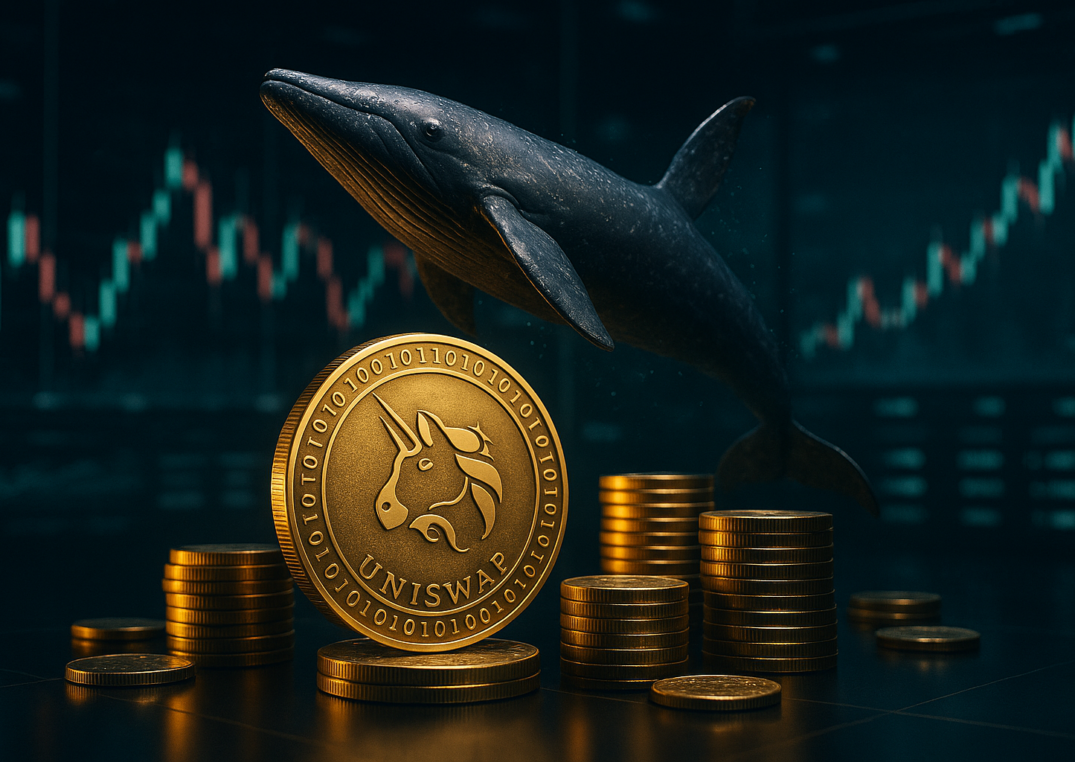
Uniswap Whale Activity Jumps as Standard Chartered Sets $100 UNI Target by 2030
Meta Description: Uniswap (UNI) rallied as whale transactions hit a seven-month high after Standard Chartered projected $100 by 2030, citing rapid growth in tokenized assets.
Key Takeaways
- Whale transactions on Uniswap reached a seven-month high, with active whale addresses at a four-month peak, according to Santiment.
- Standard Chartered’s research team projected UNI at $100 by 2030, tied to a multi-trillion-dollar expansion in tokenized assets.
- UNI traded near $3.10 after touching $3.65, its highest level since mid-May, with weekly gains near 24% per CoinGecko.
- Uniswap said tokenized equities such as Apple, Tesla, and NVIDIA are accessible via its app and API; earlier in the year, UniswapX enabled access to BlackRock’s BUIDL tokenized fund.
- The bank’s base path envisions UNI at $6.50 by year-end, $20 by 2027, $40 by end-2028, and $65 by 2029 before reaching $100 in 2030.
Uniswap’s UNI token drew fresh attention this week as network activity accelerated and large holders stepped in following a new institutional forecast. Santiment reported that whale transactions climbed to a seven-month high and active whale addresses hit a four-month peak, coinciding with Standard Chartered’s research team outlining a $100 price target for UNI by 2030. The bank’s thesis is anchored to a sharp rise in tokenized assets migrating on-chain over the next few years, a trend it believes could funnel significant volumes through Uniswap’s liquidity pools.
Market Movement
Price action followed the research note and social media chatter. UNI was recently changing hands near $3.10 and briefly reached $3.65 in the prior 24 hours, its highest mark since mid-May, according to CoinGecko. The token advanced roughly 24% over the last week and about 16% across 14 days, though it remained lower by nearly 12% on a one-month basis and down about 58% year-on-year. Those swings underscore how quickly sentiment in decentralized finance can pivot when a high-profile forecast intersects with rising on-chain activity.
Standard Chartered’s outlook offered a staged path: $6.50 by the end of this year, $20 by 2027, $40 by the end of 2028, and $65 by 2029 on the way to $100 by 2030. The bank framed the potential rerating within an expected surge in tokenized assets to about $4 trillion by the end of 2028, up from around $340 billion today. In that scenario, tokenized assets active in DeFi could multiply at least 37 times in four years—a scale that, in the team’s view, could be mirrored in Uniswap’s liquidity pools.
Trading Activity
Santiment’s on-chain data captured the near-term response. “Uniswap shocked traders with a +24% surge and massive whale activity and volume,” the analytics firm said on June 17. A day later, Santiment noted that active addresses had reached a four-month high and whale transactions had risen to levels last seen seven months ago. The acceleration in large transfers and address activity often signals that high-net-worth investors, funds, or sophisticated traders are repositioning, adding depth to liquidity while amplifying intraday volatility.
Whale behavior is closely watched across DeFi precisely because it can compress or extend short-term trends. When large addresses accumulate, order books and pools can absorb more size without steep price impact; when they distribute, spreads can widen and slippage can rise. The recent pickup in whale-driven transfers on Uniswap points to heightened conviction—or at least a willingness among big players to express views—following the institutional narrative around tokenization and UNI’s role in that landscape.
Investor Sentiment
The Standard Chartered note tied UNI’s long-term upside to an expanding universe of tokenized assets and to Uniswap’s positioning as a general-purpose trading infrastructure with strong brand recognition. The bank also highlighted the protocol’s dominance in trading highly correlated asset pairs and characterized Uniswap as the largest decentralized exchange by footprint—factors it believes support market share resilience as on-chain volumes diversify.
Beyond the forecast headline, two product developments provided tangible catalysts for sentiment. Uniswap confirmed that tokenized equities such as Apple, Tesla, and NVIDIA are available through its app and API, bringing a familiar equity exposure into on-chain rails. Earlier in the year, UniswapX—Uniswap’s aggregator—enabled trading access to BlackRock’s BUIDL tokenized fund, an event that drew broad attention and coincided with a 40% gain in UNI at the time. For traders, those steps illustrate how Uniswap is extending its reach beyond traditional crypto pairs toward a broader tokenized-asset venue.
That narrative—backed by a household-name financial institution’s projections—helped shift focus from UNI’s trailing performance to its forward setup. The bank’s team suggested that UNI, then the #45 token by market capitalization when the note was published, could outperform Bitcoin and Ethereum through the forecast horizon. While such calls are difficult to handicap across multi-year windows, the combination of whale accumulation, rising address activity, and product milestones gave traders near-term reasons to reprice risk.
Broader Market Context
The core of the bank’s thesis hinges on scale. If tokenized assets on public chains grow from roughly $340 billion to near $4 trillion by the end of 2028, the composition of on-chain flows could change materially. In that setting, routing efficiency and deep liquidity across correlated pairs would be pivotal. Uniswap’s pools are built to facilitate permissionless trading across a wide range of ERC-20 tokens and, increasingly, tokenized representations of off-chain instruments. Should tokenization proliferate, the liquidity network effect could strengthen around a handful of venues where counterparties consistently find price, size, and low slippage.
For market participants, that shift could filter through several layers. Liquidity providers may recalibrate capital allocation across pools that reference similar underlying exposures, expecting tighter spreads and higher turnover as tokenized assets list in greater numbers. Arbitrageurs could see more frequent cross-pool opportunities as price relationships tighten across correlated instruments. And passive holders might benefit from improved market depth that cushions volatility in both risk-on rallies and drawdowns, provided that pool incentives and fee structures keep LPs engaged.
The scale argument also extends to data. As more tokenized instruments settle on public ledgers, analytics around address behavior, pool utilization, and routing paths become richer. The recent Santiment readings offer a preview of that feedback loop: when activity spikes, it not only moves price but also pulls in incremental liquidity, which then influences routing decisions and the realized cost of execution. In time, those dynamics can solidify into durable market structure.
Industry Impact
Uniswap’s confirmation that tokenized equities are accessible via its app and API reflects a pragmatic approach to meeting demand where it’s emerging. For developers and integrators, API access simplifies the task of plugging tokenized exposures into wallets, analytics dashboards, and trading tools. For professional traders, the availability of recognizable equities on-chain broadens collateral options and hedging strategies inside DeFi toolkits.
The earlier integration of access to BlackRock’s BUIDL tokenized fund through UniswapX underscored how blue-chip financial products can intersect with decentralized routing. Although BUIDL is structured for specific investor cohorts, its presence in on-chain liquidity venues helped spotlight Uniswap’s role as an aggregator that can connect to a range of sources while abstracting execution for end users. The attention around that event coincided with a 40% move in UNI, emphasizing how product milestones can catalyze flows even before long-term adoption curves fully materialize.
Standard Chartered’s projection that tokenized assets active in DeFi could multiply at least 37 times over four years carries implications for infrastructure resilience. Smart contract reliability, efficient fee markets, and robust liquidity incentives become core determinants of whether venues like Uniswap can scale without compromising user experience. With more assets tokenizing, the breadth of correlated pairs could expand, reinforcing Uniswap’s stated strength in that segment and potentially stabilizing pricing across venues during volatile periods.
What This Means for Crypto Markets
For portfolio managers, the immediate takeaway is the renewed sensitivity of UNI to institutional narratives and on-chain signals. Whale participation at seven-month highs and a visible bump in active addresses indicate that larger players are engaging. That participation often precedes deeper liquidity and can support tighter spreads, both of which are conducive to systematic strategies and block execution. The near-term trading implication is a higher probability of trend extension when such activity clusters, tempered by the risk of swift reversals if large holders pivot.
At the strategy level, the tokenization theme gives catalysts a longer half-life. When tokenized assets grow, routing preferences coalesce around venues that consistently offer best execution across correlated instruments. If Uniswap retains its advantage in those pairs, as the bank’s team suggests, flows could become stickier, making episodic spikes in whale activity less idiosyncratic and more structural. That scenario would also shape how LPs think about fee tiers, capital concentration, and duration risk in their positions.
Risk considerations remain. The path from hundreds of billions to multiple trillions in tokenized assets involves operational, technical, and market-structure hurdles. Execution quality, custody standards, and composability risks will influence how quickly traditional assets find their way on-chain in forms that large investors are prepared to use at scale. Even so, the alignment of institutional forecasts, product rollouts that extend Uniswap’s reach, and measurable upticks in on-chain participation forms a coherent, data-backed narrative for traders assessing UNI’s setup.
The bank’s explicit price path—$6.50 by year-end; $20, $40, and $65 through 2029; and $100 by 2030—offers a scaffold against which the market can test adoption milestones. Each interval provides a natural checkpoint for whether tokenized flow is deepening, whether correlated pairs on Uniswap are absorbing more size without wider spreads, and whether LP economics are attracting sustained capital. The projection that UNI could outperform larger benchmarks like Bitcoin and Ethereum over that horizon adds a relative-value lens to allocation decisions, even if the ultimate outcome will hinge on realized volumes.
Conclusion
Uniswap’s rebound in on-chain activity this week—marked by a seven-month high in whale transactions and a four-month peak in active whale addresses—landed at the same moment Standard Chartered linked UNI’s long-term value to a multi-trillion-dollar expansion in tokenized assets. UNI’s push to $3.65 before easing back near $3.10, alongside weekly gains near 24%, reflects that confluence of institutional narrative and measurable network participation.
With tokenized equities now accessible via Uniswap’s app and API and earlier access to BlackRock’s BUIDL fund routed through UniswapX, the protocol is positioning for a broader spectrum of on-chain assets. If the bank’s growth assumptions materialize and tokenized instruments increasingly rely on decentralized liquidity, Uniswap’s general-purpose infrastructure and brand recognition may keep it at the center of that flow. For traders, the signal is clear: UNI has re-entered the conversation where long-horizon forecasts meet near-term whale engagement, and the next milestones will be tracked not just in price but in the depth and persistence of on-chain activity.
