


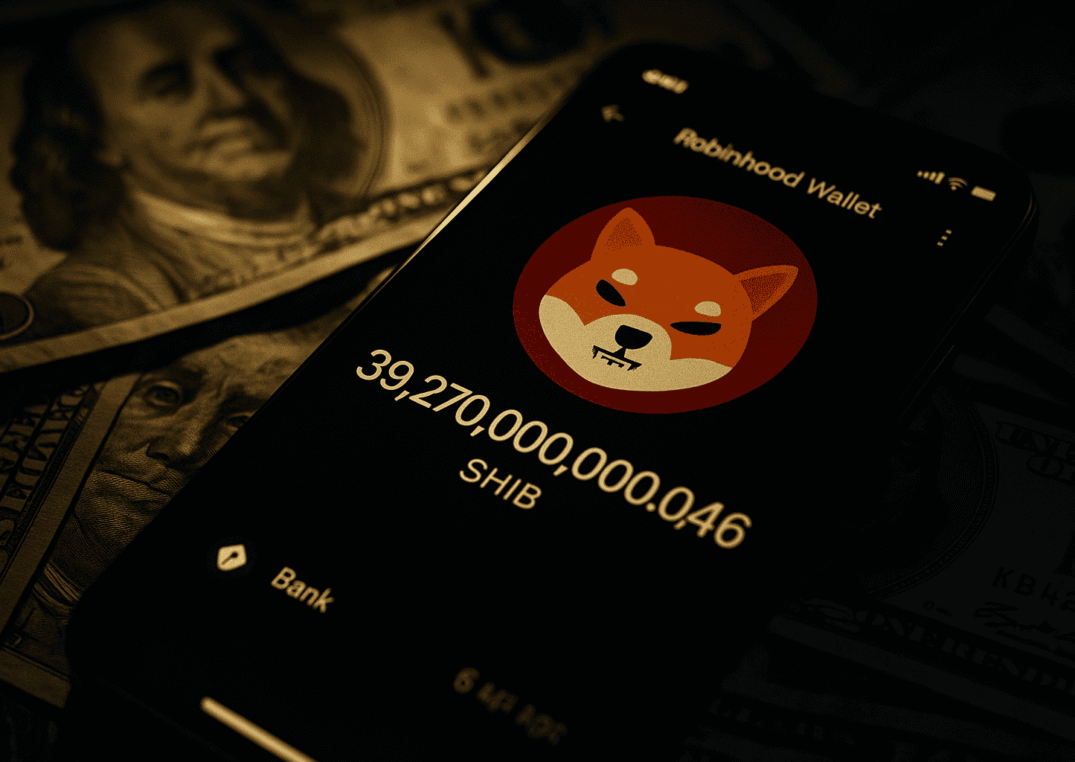
Shiba Inu: Robinhood Wallet Holds 39.27T SHIB While Burn Address Holds 41% of Supply; T. Rowe Price ETF Begins Trading
Key Takeaways
- A Robinhood‑named wallet holds 39,273,242,865,360.9000 SHIB, equal to 3.9274% of supply and valued at $161,805,760.61, according to Etherscan.
- Shiba Inu’s burn address is the single largest holder with 410,433,377,893,806 SHIB, or 41.0441% of supply; Vitalik Buterin’s May 2021 burn exceeded 410 trillion tokens.
- T. Rowe Price’s Active Crypto ETF (TKNZ) began trading Thursday with exposure to a portfolio of crypto assets including SHIB; SHIB trades at $0.00000413, down 0.71% over 24 hours.
Robinhood remains atop Shiba Inu’s holder list with more than 39.27 trillion SHIB in a wallet tied to the brokerage platform, even as the project’s burn address dominates overall holdings with just over 41% of supply. The concentration update lands as T. Rowe Price’s actively managed multi‑token spot crypto ETF starts trading with exposure that includes Shiba Inu, and as SHIB edges lower alongside a broader market pullback.
What Happened
Fresh Etherscan data shows a Robinhood‑named wallet currently holding 39,273,242,865,360.9000 SHIB, equivalent to 3.9274% of Shiba Inu’s circulating supply and valued at $161,805,760.61. While large, that position is eclipsed by Shiba Inu’s burn address, which holds the biggest share of tokens: 410,433,377,893,806 SHIB, or 41.0441% of supply, valued at $1,695,089,850.
By design, tokens sent to a burn address are permanently removed from circulation because the address has no known private key and cannot be accessed. That dead‑wallet balance was substantially built by Ethereum creator Vitalik Buterin’s May 2021 transaction, in which he sent more than 410 trillion SHIB to the burn address—valued at $6.7 billion at the time—locking those tokens out of use and shrinking effective supply.
Shiba Inu’s deflationary cadence continues: 3.43 million SHIB were burned in the last 24 hours. Outside of the burn wallet, the remaining 58.06% of supply is dispersed mostly across exchanges—where platforms hold larger amounts on behalf of users—and individual wallets. Whales account for 0.04% of holders.

Separately, T. Rowe Price launched what it describes as the industry’s first actively managed multi‑token spot crypto exchange‑traded fund. The T. Rowe Price Active Crypto ETF (TKNZ) began trading Thursday and offers investors exposure to a portfolio of crypto assets that includes Shiba Inu.
Market Reaction
At the time of writing, SHIB is down 0.71% over the last 24 hours to $0.00000413. The move comes as a selloff in Asian semiconductor shares pulled every major cryptocurrency lower. The broader crypto market is consolidating, with on‑chain metrics yet to confirm a reversal. Sentiment remains fragile, with the Fear and Greed Index at 31—firmly in fear territory.
Trading and On-Chain Activity
The latest wallet composition underscores two dynamics that traders track closely: exchange‑linked balances and permanent supply reduction. The Robinhood‑named wallet holds 3.9274% of supply, a material concentration that can influence liquidity perceptions. Meanwhile, the burn address—now at 41.0441% of supply—continues to represent a significant portion of tokens that are effectively out of circulation.
Deflationary pressure persists, with 3.43 million SHIB burned in the past 24 hours. While the figure is small relative to overall supply, consistent burning contributes incrementally to reduced float over time. Market participants often monitor burn cadence for clues about long‑term supply trends alongside other on‑chain indicators.
Distribution beyond the burn address remains broad: 58.06% of the supply is shared mostly among exchanges and individual holders, and whales comprise 0.04% of the holder base. For traders, this split can inform assessments of potential supply overhang on exchanges versus longer‑term holding behavior in individual wallets.
Why This Matters Now
The simultaneous update on SHIB holdings and the launch of an actively managed, multi‑token spot crypto ETF has near‑term relevance for positioning and liquidity. Large, identifiable wallets—including those associated with major trading platforms—provide a read on where significant token stacks reside. At the same time, an ETF that includes SHIB can influence how some investors gain exposure and may alter the profile of demand across market cycles.
With sentiment in fear and broader crypto consolidating, concentration and burn trends take on added importance. They provide a supply‑side anchor against a backdrop where price is being driven in part by macro cross‑currents—such as the selloff in Asian semiconductor shares—that can trigger synchronized risk‑off moves across digital assets.
Broader Market Context
Crypto markets are in a consolidation phase, and on‑chain metrics have yet to signal a confirmed reversal. That leaves price discovery susceptible to headline‑driven flows and external risk factors. In that context, SHIB’s 0.71% daily dip to $0.00000413 aligns with the day’s broader risk tone, as weakness in Asian semiconductor equities dragged major cryptocurrencies lower.
Positioning indicators echo caution: the Fear and Greed Index sits at 31, reflecting a market still in fear territory. For SHIB, concentration at the burn address and continuing, albeit modest, daily burns help frame supply dynamics while the distribution across exchanges and individual wallets sets the stage for how quickly tokens could move in response to shifting sentiment.
Implications for Investors and Traders
For short‑term traders, the immediate takeaway is twofold: SHIB’s price is tracking broader risk sentiment, and on‑chain signals have not yet confirmed a trend reversal. In that environment, liquidity conditions and wallet flows around large addresses—such as the Robinhood‑named wallet—remain relevant inputs for intraday strategy and risk management.
For medium‑term investors, sustained burns and the substantial dead‑wallet balance continue to underpin a deflationary narrative. While current daily burns are small relative to total supply, the cumulative effect contributes to a lower circulating base over time. The inclusion of SHIB in T. Rowe Price’s actively managed multi‑token spot ETF provides an additional avenue for exposure that some investors may prefer, potentially diversifying access points alongside centralized exchanges and self‑custody.
Portfolio construction considerations remain sensitive to market tone: with the Fear and Greed Index at 31 and consolidation in place, position sizing, stop discipline, and monitoring of exchange‑held balances are likely to be top of mind. The split of 58.06% of supply across exchanges and individual wallets and the small share of whales (0.04% of holders) help contextualize where tokens are parked and how swiftly liquidity might shift if sentiment changes.
What’s Next
Traders will watch whether the launch of the T. Rowe Price Active Crypto ETF (TKNZ) draws incremental interest to assets within its portfolio, including Shiba Inu, and whether any resulting flows show up in exchange balances and price behavior. Attention will also stay on burn‑rate momentum and movements around the Robinhood‑named wallet as part of routine on‑chain surveillance.
With crypto markets consolidating and risk appetite cautious, confirmation from on‑chain metrics would be needed to strengthen the case for a durable trend change. Until then, SHIB’s supply structure—dominated by the burn address, significant exchange‑linked holdings, and a persistent though modest burn cadence—remains a core part of the investment and trading equation.
