


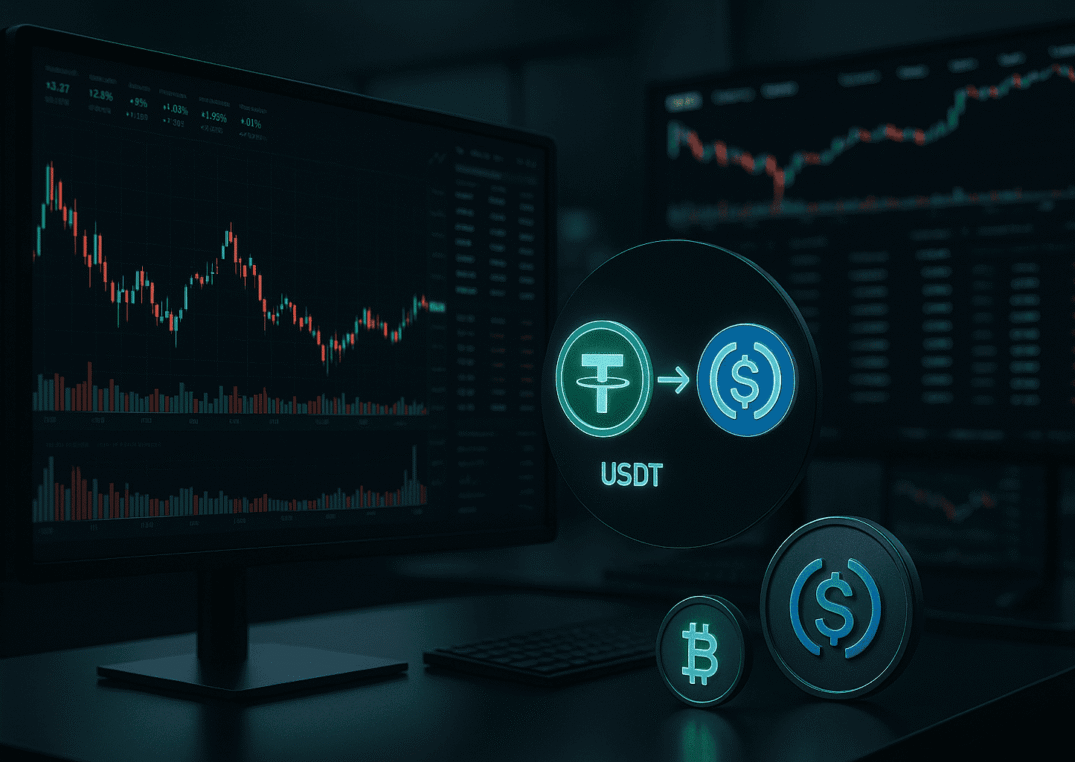
OKX Europe Launches One-Way USDT-to-USDC Conversion as MiCA Limits Tether Support
Key Takeaways
- OKX Europe introduced a one-way conversion that lets customers deposit USDT and convert it to USDC, creating a regulated migration path under MiCA.
- Tether has not obtained MiCA authorization, prompting platforms to restrict USDT and shift users to compliant stablecoins.
- USDT remains dominant globally, accounting for about 59% of a nearly $310B stablecoin market; USDC’s market cap is roughly $73B.
OKX Europe has rolled out a one-way conversion feature that allows customers to deposit USDT and convert it into USDC, providing a regulated option for users navigating the European Union’s Markets in Crypto-Assets (MiCA) rules, which limit support for the world’s largest stablecoin. The exchange said conversions can be made at customers’ discretion, rather than on a platform-imposed deadline—an operational detail that matters to traders managing liquidity and timing of transfers.
The Development
According to a company announcement shared with Cointelegraph, the new OKX Europe feature enables users to deposit Tether’s USDt (USDT) into their OKX Europe account and convert those balances into USDC. The exchange positioned the tool as a regulated migration path for users whose existing platforms no longer accept USDT or plan to move balances automatically to compliant alternatives.
The product lands as the EU completes MiCA’s rollout on July 1 and as crypto exchanges in the region adapt to the framework’s stablecoin requirements. Tether has not obtained authorization to issue USDT under MiCA, which has led many European platforms to restrict deposits, delist USDT trading pairs, or convert customer balances into alternatives that are available within the framework. OKX Europe serves customers across 30 EU and European Economic Area countries under its MiCA license.
Trading Volume and Activity
Despite the regulatory shift in Europe, USDT remains the market’s primary trading lubricant. Per DefiLlama data cited by the company, Tether accounts for about 59% of the nearly $310 billion stablecoin market, with a market capitalization of roughly $184 billion. Circle’s USDC stands as one of the largest compliant alternatives, with a market cap of about $73 billion. For spot and derivatives venues, these relative sizes help explain why migration mechanics matter: market makers, arbitrageurs, and active retail participants typically source and settle in the most ubiquitous stablecoin rails.

In practice, the one-way conversion at OKX Europe gives users a mechanism to bridge USDT liquidity into USDC within a MiCA-licensed environment. While the feature does not itself change aggregate volumes, it can smooth operational frictions associated with moving capital from platforms that now restrict USDT to venues where USDC is supported. The ability to time the conversion at a trader’s discretion may also help reduce execution slippage around fixed migration cutoffs on other platforms.
Market and User Impact
For European users who still receive transfers or maintain balances in USDT—because counterparties outside the EU continue to transact in it—the OKX Europe tool offers a way to maintain access to liquidity on a compliant exchange without relying on ad hoc off-platform conversions. The exchange’s one-way approach also sets clear expectations: users can bring in USDT and convert to USDC, aligning with the regulatory direction while preserving continuity of trading activity.
The timing flexibility is notable. Some platforms have adopted firm deadlines that trigger automatic conversions or balance actions. OKX Europe stated that conversions on its venue are voluntary and can be completed at the customer’s discretion. That operational stance could appeal to systematic traders who need to coordinate treasury movements with strategy cycles or settlement windows.
Competitive Landscape
MiCA’s rollout is already reshaping product menus across European crypto exchanges and fintech platforms. As Tether remains unauthorized under the framework, the regional trend has been to restrict USDT support and steer users toward compliant alternatives such as USDC. Digital banking platform Revolut, for example, said it will stop supporting USDT for customers in the European Economic Area and Switzerland, giving users until August 31 to sell or withdraw before automatically converting any remaining balances into their base currency.
In this environment, exchange-level tools that facilitate orderly migration are becoming competitive differentiators. OKX Europe’s one-way conversion is intended to offer a user-led, regulated path rather than an exchange-imposed conversion timetable. For professional users, the benefit is operational control: firms can align conversion flows with market conditions, liquidity windows, and internal risk thresholds, while ensuring assets remain within a MiCA-licensed perimeter.
Regulatory and Compliance Context
MiCA established a pan-EU regime for crypto-asset service providers and stablecoin issuers, with rules for reserve holdings and disclosures. Since parts of the framework began taking effect in late 2024 and the rollout completed on July 1, European exchanges have been shifting users toward MiCA-compliant stablecoins.
Tether has defended its decision not to seek authorization for USDT under MiCA. CEO Paolo Ardoino has criticized aspects of the framework—particularly reserve requirements that would mandate holding a portion of reserves with European credit institutions—arguing that such provisions introduce unnecessary risks for stablecoin issuers. In a May 2025 interview, he described MiCA as “very dangerous when it comes to stablecoins,” and in July 2025 said Tether would reconsider seeking authorization only when the framework becomes safer for consumers and issuers. To date, the company has shown little sign of changing course.
Implications for Traders
For market participants operating across both European and non-European venues, the operational takeaway is straightforward: USDT remains the deepest global liquidity pool, but its support in the EU is constrained by MiCA. OKX Europe’s one-way USDT-to-USDC conversion gives traders a practical bridge to maintain access to compliant liquidity without relying on external OTC conversions or informal workarounds.
Portfolio and treasury teams may leverage the feature to centralize stablecoin balances in USDC on a MiCA-licensed exchange, aligning custody and compliance needs with day-to-day trading. The absence of a platform-imposed deadline allows users to choose windows of lower volatility or higher book depth for conversions, potentially minimizing spread costs and market impact. For funds and market makers, that timing control can be material in roll periods or during event-driven bursts in volumes.
What’s Next
The broader European stablecoin landscape will continue to be defined by the interplay between MiCA compliance and global liquidity patterns. Exchanges in the region are already nudging users toward compliant assets and building tools that manage the transition. With USDT still commanding a majority share of the global stablecoin market and USDC positioned as a leading MiCA-available alternative, attention now turns to how effectively platforms can streamline user flows under the new rules.
In the near term, traders should monitor venue-level feature rollouts similar to OKX Europe’s one-way conversion, evolving platform policies on USDT support within the EU, and any further user-action deadlines from non-exchange fintechs. As more platforms restrict or delist USDT in Europe, mechanisms that preserve trading continuity—while giving users discretion over the pace of migration—are likely to shape how liquidity concentrates across compliant stablecoin pairs on EU venues.
