


European Banking Authority Sets MiCA Fines Blueprint Ahead of EU Licensing Deadline as Binance Curbs Services
Meta Description: European Banking Authority outlines MiCA fines up to 12.5% for significant tokens as the EU’s July 1 licensing cutoff nears; Binance prepares EU service limits.
Key Takeaways
- EBA publishes a MiCA penalty methodology using a two-step approach to fine non-compliant issuers of “significant” tokens.
- Proposed caps reach 12.5% of annual turnover for significant asset-referenced tokens and 10% for significant e-money tokens, or twice the profits from violations.
- Framework lands days before the EU’s July 1 licensing deadline; Binance notifies EU users of service restrictions starting that day.
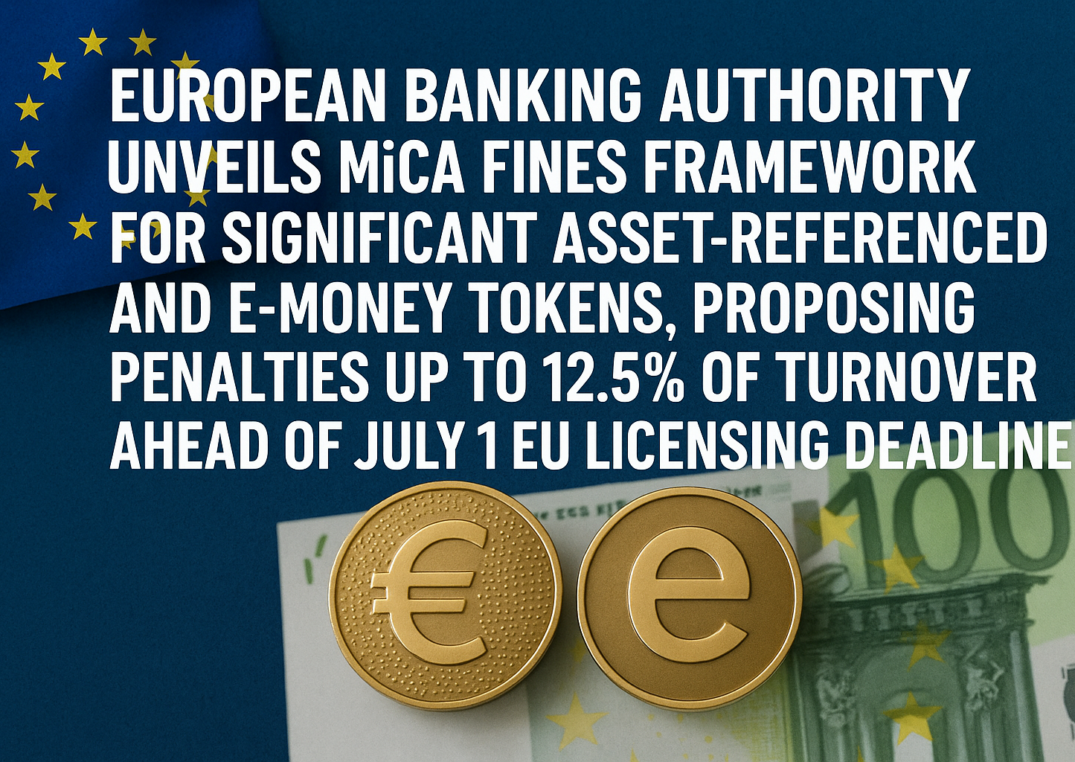
The European Banking Authority (EBA) has proposed a standardized methodology for setting fines under the European Union’s Markets in Crypto-Assets (MiCA) regime, detailing how it plans to penalize issuers of “significant” tokens that breach the bloc’s rules. The consultation paper, published June 26, describes a two-step process to determine penalties and sets ceilings that can reach up to 12.5% of annual turnover for significant asset-referenced token issuers, 10% for significant e-money token issuers, or two times the profits generated by a violation. The move arrives just ahead of the EU’s July 1 licensing deadline—an inflection point for exchanges and stablecoin issuers seeking access to the single market—and follows notices from Binance that it will restrict certain services for EU users from that date.
Market Movement
The EBA’s proposal gives markets clearer contours around the financial consequences of non-compliance as the MiCA rulebook comes into force. Clarity over enforcement can reshape liquidity and trading behavior by setting expectations for how national and EU-level authorities will respond to breaches, especially for issuers and platforms whose tokens or services may meet the “significant” thresholds under MiCA. While the paper is open for consultation, the architecture it sketches signals a shift from transitional flexibility to a more hard-edged supervisory stance.
MiCA’s introduction marked a first-of-its-kind, bloc-wide framework for digital assets. By tying market access to licensing and compliance obligations, the EU is steering the sector toward bank-like controls for disclosures, governance and capital. The EBA’s penalty blueprint is the enforcement counterpart: a toolset designed to deter misconduct and align incentives as firms move from grace periods to full authorization requirements.

Firms face a near-term operational pivot. By July 1, crypto companies must hold a valid license from a national regulator to legally offer services or market stablecoins across the 27-nation bloc. For those that miss the cutoff, the choice narrows to pausing certain activities or risking infractions that the EBA’s new methodology is built to penalize, such as organizational failures or unauthorized public communications tied to regulated activities.
Trading Activity
Signs of repositioning are already visible. Following the exchange’s withdrawal of its MiCA license application in Greece, Binance users in the EU received notices indicating that onboarding of new EU users will be halted and certain services limited from July 1. The exchange said customers will continue to be able to withdraw assets, consistent with applicable regulatory requirements. Around the same time, Binance recorded daily net outflows of $1.96 billion on Wednesday, followed by $2.52 billion and $1.46 billion over the next two days, according to DefiLlama data cited in the source report.
Those flow dynamics underscore how policy milestones can redirect near-term liquidity. When rules tighten or permissions lapse, trading volumes can migrate to venues and structures that retain regulatory continuity. For EU-focused market participants, the licensing cliff can compress spreads and depth on affected platforms while boosting activity where compliance status is assured. Market makers typically recalibrate inventory and connectivity to reflect where stable fiat ramps and token liquidity remain uninterrupted.
Investor Sentiment
Investor psychology around regulatory events tends to move in phases. Ahead of a clear deadline—like the EU’s July 1 cutoff—participants often de-risk operational exposure by reducing balances on platforms facing disruption, as reflected in exchange outflow data. That is followed by a reassessment period where institutions and professional traders measure the cost of compliance against the value of European market access. Issuers and service providers with visible licensing progress and robust controls may find it easier to attract sticky capital seeking lower regulatory friction.
The EBA’s penalty playbook also speaks to confidence. Markets generally price regulatory uncertainty at a discount; the closer supervisors get to codified methods—like the EBA’s two-step approach of assessing baseline severity and then adjusting for aggravating or mitigating behavior—the less room there is for ambiguity in outcomes. Even before finalization, the presence of a standard framework allows risk teams to model worst-case scenarios and adjust exposure or hedging strategies accordingly.
Broader Market Context
MiCA’s sequencing has been deliberate: define who needs authorization, set core conduct and prudential standards, and now describe how breaches translate into monetary penalties. The EBA’s paper is explicit that fines are meant to deter—capping at 12.5% of annual turnover for issuers of significant asset-referenced tokens and at 10% for significant e-money tokens, or twice the profits earned from the violation. The methodology reinforces the view that, in Europe, token issuance and distribution will be supervised under a framework closer to traditional finance than to the permissive models that characterized early crypto growth cycles.
That approach diverges from the regulation-by-enforcement path often associated with the United States. While the U.S. has advanced several high-profile cases, Europe is signaling—with licensing and now with a fining schema—that it prefers ex-ante clarity. For global firms, the contrast can influence where to domicile entities, how to structure European product lines, and which tokens to prioritize for compliance investment.
The timing is also notable. The EBA published its consultation paper on June 26, leaving a narrow window before the July 1 licensing date. Market actors now face a three-month consultation period ending September 28 to propose adjustments to the fine-setting methodology, but the supervisory stance arrives ahead of that, shaping behavior immediately as firms seek to avoid breaching rules on day one of full implementation.
Industry Impact
For issuers of “significant” tokens as defined under MiCA, the EBA’s two-step fine-setting framework raises the stakes for operational rigor. The baseline severity assessment will likely push projects to audit disclosures, test controls around reserves and governance, and document remediation paths. The second step—adjusting for aggravating or mitigating behavior—creates incentives to self-report issues, maintain clear incident logs and demonstrate effective oversight.
Exchanges and custodians also face strategic choices. Where authorization paths are taking longer than expected, some may opt to pause certain services to EU users rather than risk violations. Communications must be synchronized with supervisory expectations to avoid triggering infractions tied to unauthorized marketing or public disclosures. Firms that have already aligned to MiCA-era standards can leverage the transition to capture market share from operators still in flux.
Customer experience will vary by venue and product. Notices shared by Binance users suggest that asset withdrawals will remain available even where onboarding pauses, reducing immediate counterparty risk for clients. Yet product segmentation—what is available to EU accounts versus other regions—will likely persist until licensing gaps close. That can affect liquidity across trading pairs, especially for tokens whose issuance or distribution falls squarely within MiCA’s perimeter.
Regulatory Architecture and Enforcement Design
The EBA’s method emphasizes consistency. By first scoring the severity of a breach and then applying factors that can raise or lower the penalty, the authority aims to avoid ad hoc outcomes across member states. The upper limits—12.5% of annual turnover for significant asset-referenced tokens, 10% for significant e-money tokens, or doubling the profits from a breach—are intended as deterrents for even the largest operators, reflecting the EU’s desire to anchor the digital-asset economy in a mature compliance culture.
The proposal arrives as part of the EU’s broader effort to complete its digital finance rulebook. MiCA brought token issuers and crypto-asset service providers into a single regulatory architecture, requiring bank-like compliance, consumer protections and, for certain tokens, capital and reserve discipline as a condition for EU-wide distribution. The penalty framework rounds out that structure with the credible threat of monetary sanctions tailored to the size and behavior of the offender.
Stakeholders now have until September 28 to respond. While consultations often lead to technical refinements, the thrust of the framework—clarity, deterrence and uniformity—is unlikely to shift materially. Issuers and platforms that treat this period as a final chance to align internal processes will be better positioned when the methodology is formalized.
What This Means for Crypto Markets
In the near term, Europe-facing liquidity could fragment as unlicensed providers limit services and clients rebalance toward authorized venues. Spreads may widen temporarily on affected platforms, and some market makers could reduce quotes around tokens whose status under MiCA is most sensitive until licensing and disclosures settle. Conversely, venues with clear supervisory alignment and fully documented controls stand to benefit from deeper order books and steadier funding conditions.
For stablecoin markets, the framework reinforces a move toward higher-quality issuance standards in the EU. Issuers that can demonstrate robust governance, transparent disclosures and durable reserves should find distribution smoother across regulated European channels. Where issuers or distributors fall short, the risk-adjusted return calculus may change quickly once penalties become a live possibility.
Global firms will weigh trade-offs. Europe’s ex-ante clarity can lower legal uncertainty but raises up-front compliance costs. The U.S. enforcement-led route may preserve flexibility in some niches but leaves firms exposed to case-driven volatility. Multinational operators may increasingly adopt a region-by-region product strategy, aligning token issuance, marketing and access with the most stringent applicable standard to future-proof European distribution.
Company Actions: Binance’s EU Pause
Binance’s recent steps illustrate how operators are navigating the transition. After withdrawing its MiCA license application in Greece, the exchange notified EU users of service changes starting July 1, including a pause on onboarding new EU customers and limits on some existing services. The notices indicated that withdrawals remain available, which can help customers manage balances during the transition. The exchange also saw multi-billion dollar daily net outflows on three consecutive days in the wake of the withdrawal announcement, according to the source’s DefiLlama references.
These measures reflect a broader pattern: where authorization is not in place by the deadline, firms are opting to prevent potential breaches rather than operate in a gray zone. For active traders, that means monitoring venue-specific updates closely and preparing contingency routes for execution and custody if preferred platforms adjust access or product menus at short notice.
Risk Management and Compliance Priorities
Issuers and service providers should expect supervisors to scrutinize three areas most closely aligned with the EBA’s framework and MiCA’s objectives: accurate public disclosures, operational organization and governance, and the robustness of consumer-protection controls. Since the EBA’s methodology explicitly accounts for aggravating and mitigating behavior, firms can reduce penalty exposure by documenting incident response, enhancing audit trails and demonstrating proactive remediation where gaps are identified.
From a treasury and liquidity standpoint, maintaining redundant fiat access and diversified banking partners inside the EU could mitigate service interruptions tied to licensing transitions. For trading firms, building connectivity to multiple authorized venues and pre-validating counterparty risk under MiCA-era standards can reduce slippage and opportunity cost if liquidity shifts abruptly following supervisory actions or company announcements.
Documentation and Source Materials
The EBA’s consultation paper, published June 26, details the methodology for setting fines under MiCA and the proposed ceilings for significant tokens. Market participants can review the document directly on the EBA’s website for the full scope of the proposed approach. The authority also maintains pages outlining the regulatory treatment of asset-referenced and e-money tokens under MiCA. For reference: EBA consultation paper on MiCA fines and EBA MiCA tokens overview.
Outlook
The consultation window runs through September 28, but the practical impact begins sooner. With the July 1 authorization deadline arriving, the EBA’s fine-setting blueprint sends a message: access to the EU’s single market requires demonstrable compliance, and breaches will meet standardized financial responses. Firms already operating at MiCA’s standard are positioned to benefit from a clearer competitive field; those still in transition face a choice between short-term disruption and longer-term risk.
For investors, the coming weeks will be a test of execution resilience as European market plumbing adapts to the new regime. Liquidity may shuffle and product availability may vary by venue, but the direction of travel is clear—toward a more codified, institution-ready European crypto market with predictable supervisory guardrails.
Conclusion
The EBA’s fine-setting methodology crystallizes Europe’s intent to pair market access with enforceable standards under MiCA. Penalty caps of up to 12.5% of annual turnover for significant asset-referenced tokens and 10% for significant e-money tokens—or twice the profits tied to a breach—introduce a deterrent commensurate with the scale of leading operators. Coming just before the EU’s July 1 licensing deadline, the framework heightens the urgency for issuers and platforms to align operations, while the consultation period through September 28 offers a final channel to refine the details. For crypto markets, the message is unambiguous: the era of transitional leniency is ending, and supervisory clarity is set to define the next phase of European digital-asset trading.