


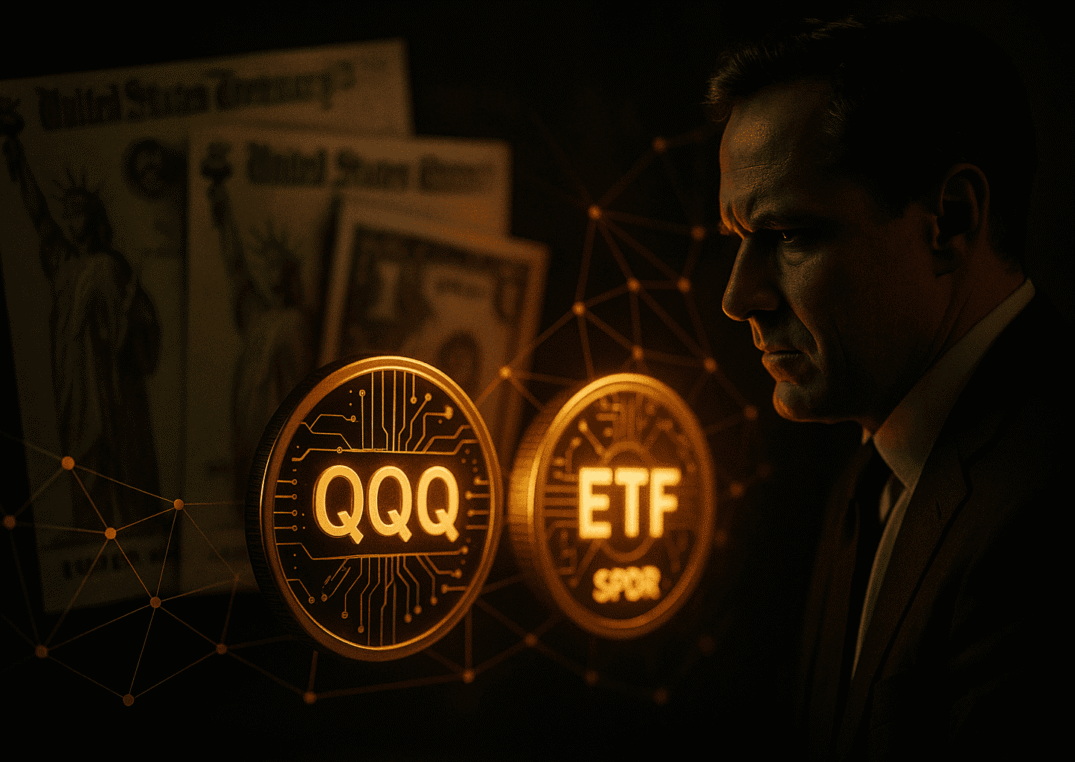
DTCC Pilots Tokenized Securities With JPMorgan, CME; QQQ and SPDR S&P 500 Tokenized
Key Takeaways
- DTCC’s tokenization model converts existing securities into blockchain-based “digital twins” that preserve legal ownership, dividend and governance rights.
- JPMorgan demonstrated converting Invesco QQQ Trust ETF holdings and using tokenized collateral to satisfy central counterparty margin requirements with CME Group.
- DTCC processed tokenized Treasury transactions, equity trades and collateral pledges; the SPDR S&P 500 ETF Trust was also tokenized during the event.
DTCC, which safeguards more than $114 trillion in securities, showcased a pilot that turns traditional assets into blockchain-based “digital twins” while preserving the full legal rights of the underlying securities. Demonstrations included JPMorgan converting holdings of the Invesco QQQ Trust ETF and using tokenized collateral with CME Group, as well as tokenized transactions spanning Treasuries, equities and collateral pledges. The SPDR S&P 500 ETF Trust was also tokenized during the event, underscoring the effort’s focus on widely held market instruments.
What Happened
The market infrastructure giant emphasized that it is not creating new digital assets. Instead, its system maps existing securities onto blockchain-based tokens that retain the same legal ownership, dividend and governance rights as the original instruments. That approach sets DTCC apart from tokenized “wrappers” that mirror prices but do not necessarily confer shareholder rights. DTCC’s model is designed to let institutions move assets between traditional electronic records and blockchain tokens without changing ownership.
“They’re the ones who are flipping from one settlement regime to the next,” said Mark Wendland, CEO of Canton Strategic Holdings. “I cannot understate the importance of a firm like DTC piloting and doing these real transactions given the role they play in U.S. financial markets.”

Throughout the demonstrations, participants executed several live use cases. JPMorgan converted holdings of the Invesco QQQ Trust ETF into tokenized assets and used the resulting tokenized collateral to satisfy central counterparty margin requirements with CME Group. DTCC also processed tokenized Treasury transactions, equity trades and collateral pledges, and the SPDR S&P 500 ETF Trust—one of the world’s largest ETFs—was tokenized during the event.
Market Reaction
The development centers on core market plumbing rather than on a single crypto asset price. While the demonstrations did not include public pricing data, traders and portfolio managers will be attentive to whether tokenized collateral and equity transactions can be replicated at greater scale across widely used instruments such as Treasuries and large ETFs.
Trading and On-Chain Activity
The workflow highlighted in the event demonstrates how institutions could convert familiar securities into blockchain-based tokens and then deploy those tokens in standard market functions—most notably as collateral for margining with a central counterparty. The ability to render Treasuries, equity positions and ETF shares as tokenized assets, and to pledge them as collateral, points to a path where collateral movements and trade lifecycle events happen on-chain while preserving the legal and economic attributes of the underlying instruments.
Unlike tokenized “wrappers” that are detached from shareholder rights, DTCC’s digital-twin design keeps the original rights framework intact. That distinction matters for trading operations that depend on accurate ownership records for corporate actions, dividends and voting, and for collateral processes that must reflect the same risk and rights profile as the base security.
Why This Matters Now
DTCC’s role as a central piece of market infrastructure means its approach can influence how tokenization is adopted across the securities ecosystem. By enabling conversion between traditional records and blockchain tokens without altering ownership, the model seeks to integrate distributed ledger technology into existing processes rather than route around them. For institutions that require continuity of legal rights and reliable settlement data, this “digital twin” structure addresses a key barrier to experimenting with blockchain rails.
The demonstrations cut across multiple asset types—ETFs, Treasuries and equities—and across critical market functions like collateral pledging and central counterparty margining. That breadth suggests tokenization’s near-term utility may be in operational workflows where custody integrity and rights preservation are non-negotiable.
Broader Market Context
Many tokenized stock offerings on crypto platforms replicate price exposure but may not grant the legal rights of the underlying shares. DTCC explicitly drew a line between those wrappers and its approach. By keeping legal ownership, dividend and governance rights with the tokenized representation, the digital twin is intended to be a one-to-one mapping of an existing security rather than a separate synthetic instrument. For regulated institutions, that distinction is central to how assets are recorded, pledged and reported.
The inclusion of high-profile ETFs such as the Invesco QQQ Trust and the SPDR S&P 500 ETF Trust, along with Treasury transactions and equity trades, underscores a focus on assets that sit at the core of institutional portfolios and collateral frameworks. Bringing those instruments onto blockchain-based rails—while preserving their rights—targets points in the market where settlement integrity and collateral mobility are most consequential.
Implications for Investors and Traders
For investors, a tokenization model that preserves rights and ownership continuity may open the door to blockchain-based workflows without sacrificing the protections and entitlements of traditional custody. For traders and treasury teams, the ability to tokenize widely used collateral—ETFs, equities and Treasuries—and to deploy it for central counterparty margining indicates a route to test on-chain collateral movements in a form that aligns with existing risk, compliance and governance checks.
If further pilots maintain the same ownership precision while supporting everyday operational tasks such as pledging, margining and trade settlement, tokenization could become less about speculative instruments and more about improving how core securities are processed behind the scenes. The demonstrations described here point squarely at that operational layer.
What’s Next
DTCC’s demonstrations show a blueprint: convert existing securities into blockchain-based digital twins, keep all legal rights intact, and use those tokens in established market processes. Market participants will be watching for follow-on pilots, expanded asset coverage and evidence that tokenized collateral and trades can be integrated into routine workflows at scale. As institutions evaluate tokenized Treasuries, equities and ETF shares for collateral and settlement, adoption will likely hinge on whether the digital-twin approach continues to match the legal and operational rigor of traditional records while offering a more flexible way to move assets across systems.
