


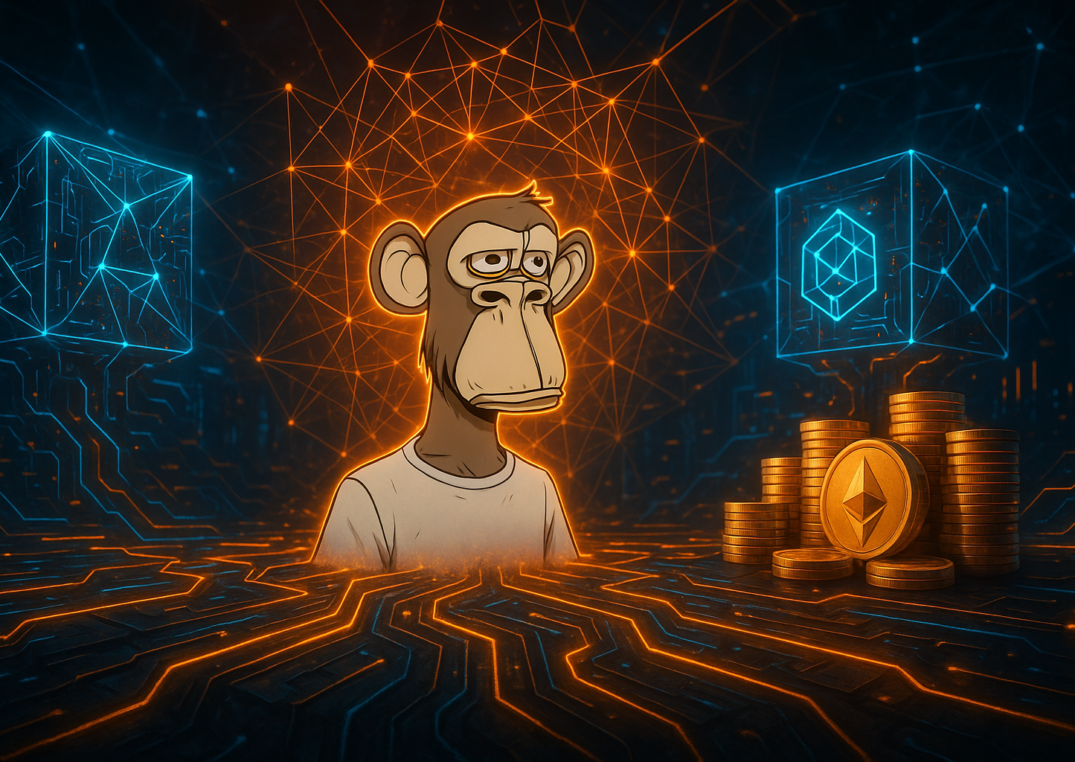
Bored Ape Yacht Club (BAYC) non-fungible tokens are climbing again, reviving expectations that a wider NFT recovery could be taking shape as risk appetite returns across crypto markets. Floor prices for the flagship Yuga Labs collection have risen from around 5 ETH to 10 ETH over the past month, and apecoin (APE), the ecosystem’s governance token, has advanced from below $0.10 to about $0.16 alongside a sharp pickup in trading activity.
Market Impact
The move in BAYC coincides with a market phase in which memecoins and other higher-beta digital assets have outpaced more defensive segments such as decentralized finance (DeFi). The outperformance suggests retail traders may be re-engaging after months of muted participation, with liquidity clustering around highly visible, community-driven assets. For NFT participants, the doubling in the BAYC floor has become a focal data point, not just for price watchers but also for those tracking onchain engagement and trading intensity across marketplaces.
Michael Figge, Yuga Labs’ newly appointed CEO, told CoinDesk that he sees the rebound as more than a burst of short-term enthusiasm. He argued that leading collections had been “oversold,” noting that while prices compressed, unique holders increased. From his perspective, that divergence revealed a disconnect between valuations and user participation during the downturn. He added that the latest price recovery looks like a reversion from a period where the market fell disproportionately.
Momentum is not confined to a single collection. Pudgy Penguins, another major series, has rallied in recent weeks, and traders are also speculating that OpenSea — the marketplace most associated with the 2021 NFT boom — could re-energize activity if a long-rumored token launch materializes. Beyond profile pictures, NFT financial activity has seen high-profile transactions: an NFT-backed loan of roughly $2.8 million tied to a CryptoPunk circulated on social media, with the lender set to earn about $138,000 in interest over a 90-day term, in what traders described as one of the larger loans of its kind.
AI Integration
As prices and volumes accelerate, crypto-native data analysis increasingly frames the discussion. In practice, market participants monitor floor-price movements, holder distribution, and marketplace flows using quantitative dashboards; many of these analytical workflows incorporate automation and pattern recognition to map liquidity and identify shifts in participation. In NFT markets, where order books are fragmented across platforms and listings update constantly, tools that can ingest onchain data quickly and flag changes in depth or velocity are central to how traders interpret trend durability.
This analytics-heavy approach also shapes how collections are assessed alongside their communities. The emphasis on unique holders highlighted by Figge is one example of a metric that data-driven traders track to gauge whether rising prices align with broadening ownership. Observers commonly compare supply concentration, listing behavior, and time-held patterns to determine whether a rally reflects genuine reaccumulation or short-lived momentum. Automated screening methods can surface such patterns in near real time, providing a structured view of market microstructure without attributing causality to any single factor.
Technology Use Case
The rebound arrives amid a wider re-examination of digital art and onchain ownership that extends beyond price speculation. In an essay last week, the pseudonymous collector and NFT market analyst “Van” argued that, even as the speculative frenzy faded after 2021, institutional engagement with blockchain-based art continued, pointing to acquisitions and exhibitions at institutions including MoMA, Centre Pompidou and LACMA over the past four years. The essay’s contention — “The speculation died, but the medium survived” — reflects how proponents frame NFTs as a durable format for provenance and ownership that can be tracked transparently onchain.
Under that lens, market structure data becomes as important as headline prices. For collectors and traders alike, the distribution of ownership, the stability of long-term holders, and the cadence of marketplace listings are among the signals examined when determining whether a rally is sustainable. In a domain where community remains central, this information helps participants evaluate whether network effects are strengthening or if activity is concentrated in short-term flipping.
Industry Response
Yuga Labs has responded by emphasizing the social layer that underpinned the original BAYC rise. Figge said the team has pivoted “back to basics,” with more than 30 in-person meetups worldwide over the past month. He acknowledged that speculation remains a major force in the market and suggested that while cycles may rhyme, they never repeat exactly. In the current phase, community programming and engagement are intended to reinforce participation that persists beyond price swings.
Elsewhere, CoinDesk’s MemeCoin Select Index was among the top-performing digital asset sectors last week as traders rotated back into higher-beta corners of the market. The rotation comes as parts of DeFi face renewed pressure: a series of recent exploits and declining yields across lending protocols have weighed on sentiment. Against that backdrop, some market participants see NFTs as offering a different proposition — community-oriented assets whose value narratives extend beyond protocol-level returns. Figge characterized the contrast succinctly, noting that vulnerabilities in DeFi can result in sudden losses that must be addressed, whereas NFTs anchor value in communities that outlast individual price moves.
The emergence of NFT-backed credit activity adds another layer to market structure. The widely discussed CryptoPunk loan highlights how collateralization is evolving in the digital-collectible segment, drawing attention to valuation methodologies, liquidation mechanics, and interest-rate formation for non-fungible collateral. For observers focused on market plumbing, such transactions provide fresh datapoints on how lenders price risk when collateral is unique rather than fungible — and how quickly those terms adjust as floor prices change.
Back to Market Fundamentals
The ongoing BAYC rally — with floor prices doubling over the past month and APE advancing in tandem — illustrates how liquidity can return quickly to recognizable brands within the NFT landscape. It also underscores how participants increasingly rely on structured metrics to parse whether a move reflects genuine strengthening or transient momentum. While Figge cautioned that it would be naive to downplay the role of speculation, he and other voices in the market point to rising unique holders, the persistence of community events, and steady institutional interest in blockchain-based art as evidence that the underlying medium retains traction even when prices fluctuate.
For now, the NFT market remains driven by a mix of price discovery, community engagement, and evolving financial infrastructure. BAYC’s resurgence, the concurrent bid in memecoins, stress points in DeFi, and the appearance of larger NFT-collateralized loans together sketch a picture of a market rediscovering its risk appetite while reassessing how onchain assets are valued and used. Whether this moment becomes a broader inflection, participants will continue to parse floor-price dynamics, holder distribution, and marketplace activity — the same signals that have come to define decision-making across crypto’s data-rich trading environment.
