


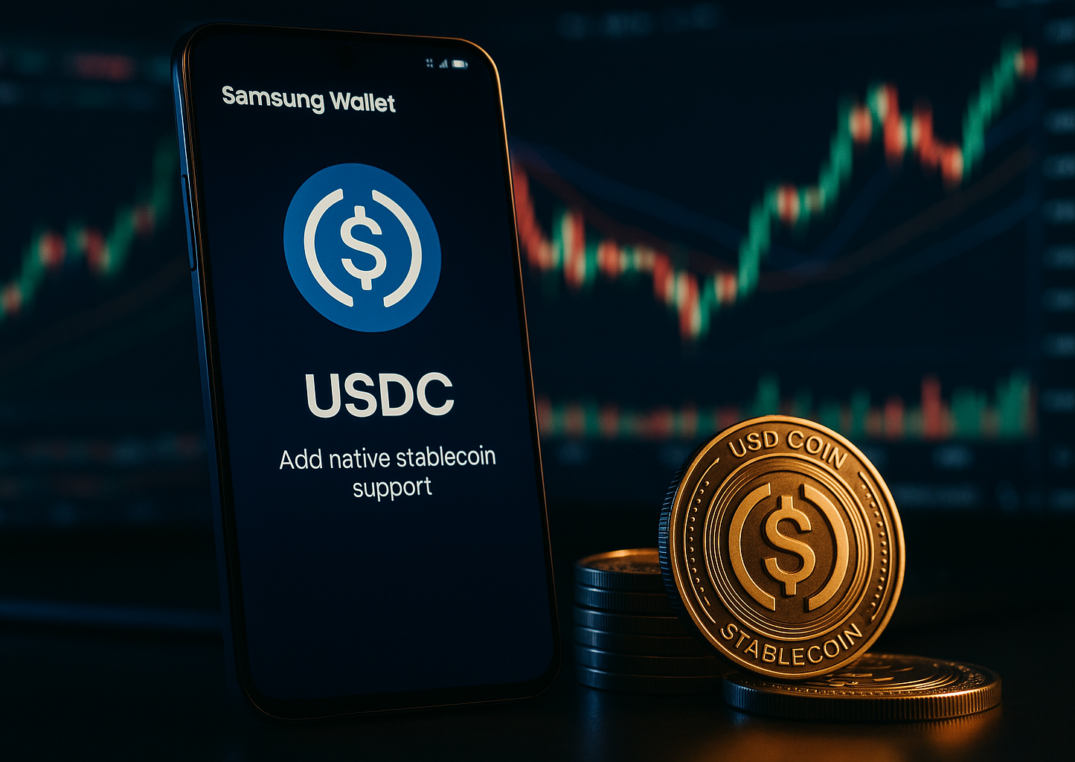
Samsung Wallet to Add Native Stablecoin Support, Showing USDC at Galaxy Unpacked
Key Takeaways
- Samsung said on July 22 in London that Samsung Wallet will add native stablecoin support, showing a mockup featuring Circle’s USDC.
- The company did not disclose a launch date, name an issuer, specify a blockchain, or clarify whether the feature will be custodial or non-custodial.
- The move builds on Samsung’s 2019 Knox-based crypto wallet, 2021 hardware wallet support, and an October 2025 Coinbase integration that reached 75 million U.S. Galaxy owners.
- The announcement arrived alongside Galaxy Card with Barclays and Visa, offering 5% cash back on Samsung purchases and 3% on Samsung Wallet transactions, as global stablecoin supply sits near $310 billion under the year-old GENIUS Act.
Samsung is pushing stablecoins into the mainstream wallet experience. At Galaxy Unpacked in London on July 22, the company said Samsung Wallet will add native support for stablecoins, showing a mockup with USDC inside the app. On stage, product manager Lee Dinham said Samsung Wallet will expand beyond cash and savings to “embrace new forms of digital value, including stablecoins,” positioning Samsung among the first major smartphone brands to bring native stablecoins to a handset. The company did not announce a launch date, an issuer relationship, or which blockchain it plans to support, and it left the custody model unspecified.
Market Overview
Native stablecoin support inside a default wallet on a leading smartphone line matters for one reason: distribution. Crypto adoption has long been constrained by setup friction and fragmented user experiences. By placing stablecoins alongside the same digital container that already stores payment cards, IDs, hotel keys, and boarding passes, Samsung is turning the experience of holding and transferring tokenized dollars into a tap-level interaction on devices that already command daily attention.
Samsung is not entering from a standing start. It embedded crypto storage into Galaxy phones in 2019 via Knox, a hardware-isolated environment gated by PIN or fingerprint, later adding support for Bitcoin, Ethereum, Tron, and Stellar. In 2021, it enabled hardware wallet connectivity, allowing devices like the Ledger Nano S to link directly to Knox. Then, in October 2025, Samsung expanded a deal with Coinbase to put crypto purchases directly inside Samsung Wallet for 75 million U.S. Galaxy owners. The company is now extending that arc from storage and access toward in-wallet tokenized cash.
The timing links hardware, payments, and rewards under a single brand experience. The stablecoin plan landed alongside Galaxy Card, Samsung’s first U.S. credit card, issued by Barclays on the Visa network with 5% cash back on Samsung purchases and 3% on Samsung Wallet transactions. Visa’s Kirk Stuart said the card reflects how “consumers expect payments to be embedded into the digital experiences they use every day.” The broader backdrop is a stablecoin market that sits near $310 billion under the year-old GENIUS Act, a context Samsung referenced as it framed its secured payments and rewards push.

Price Action and Market Structure
There was no immediate pricing detail to evaluate from Samsung’s announcement, and the company offered no timelines or asset menus beyond a USDC image in the onstage demo. Still, the structural implications are clear. When a handset vendor places a dollar-token inside its flagship wallet, it lowers the hurdle for everyday users to hold and move a digital dollar, and it can concentrate flows around the assets it chooses to present by default. If USDC ultimately features prominently, that visibility could matter at the margin for where retail and commerce-oriented stablecoin balances consolidate over time.
From a market structure perspective, OEM wallet integrations influence custody pathways. If Samsung opts for a custodial implementation, wallet balances may reside with a regulated partner, simplifying KYC, facilitating card-to-stablecoin funding, and making compliance controls more straightforward. A non-custodial path would keep users in control of keys, align with crypto’s self-custody ethos, and potentially enable direct on-chain transfers from a secure enclave. Each design choice shapes on-chain settlement patterns, exchange deposit behavior, and the balance between app-level convenience and permissionless portability.
Liquidity and Trading Activity
Stablecoins are the plumbing of crypto trading and an increasingly important bridge for consumer payments. Default exposure on Galaxy phones can affect liquidity in two ways. First, it can increase the base of users with ready access to tokenized dollars, which can translate into more stablecoin-funded activity on exchanges and in-app payment flows. Second, it can compress settlement frictions between the card world and on-chain environments when combined with a built-in on-ramp like the Coinbase integration Samsung highlighted last October for U.S. users.
That does not mean immediate volume spikes. Actual liquidity impact will depend on which stablecoins and blockchains are supported at launch, the custody model, regional availability, and merchant experiences built around Wallet. Still, expanding the distribution surface for stablecoins at the OEM level is directionally supportive for depth and velocity across retail-sized transfers and, over time, for how quickly capital moves between wallets, exchanges, and payment endpoints.
Market Context
Smartphone-native crypto features have historically been additive rather than transformative. Samsung’s Knox-based wallet in 2019 primed millions of users for secure key storage, and the 2021 hardware wallet link made self-custody more accessible to security-conscious holders. The October 2025 Coinbase integration gave U.S. Galaxy owners a direct purchase path within Samsung Wallet. Adding tokenized dollars is a logical next step that addresses a different need: making value transfer and spending as seamless as saving and buying.
Positioning also matters. By showing USDC in its demo, Samsung nodded to a regulated, fiat-backed token that is widely used in trading and payments. The company did not confirm Circle as a partner and did not specify a chain, so users and developers do not yet know whether Wallet will support a single network or multiple rails. That uncertainty is material for developers of wallets, exchanges, and consumer apps that would want to interoperate with Samsung Wallet out of the gate.
The card tie-in underscores a strategy of embedding financial features near where users already transact. With Galaxy Card offering 5% cash back on Samsung purchases and 3% on Samsung Wallet transactions, Samsung is incentivizing wallet use while building a runway for future stablecoin-based payment flows. If stablecoin balances sit next to cards and IDs, users may adopt tokenized dollars for peer-to-peer transfers and, when supported, merchant payments that benefit from instant, deterministic settlement.
Why This Matters
Stablecoins have become crypto’s highest-confidence instrument for dollar exposure and settlement, but reaching the next cohort of users requires better defaults. Samsung’s move puts stablecoins where mainstream consumers already tap and pay. For traders and investors, that can translate into:
• Market implications: A larger on-ramp for tokenized dollars tends to support the growth of stablecoin balances used for spot and derivatives collateral, even if the effect unfolds gradually.
• Investor sentiment: OEM-level support signals continued normalization of stablecoins inside consumer finance, a positive sentiment cue for assets and projects that integrate with retail wallets.
• Institutional significance: The Barclays and Visa relationships around Galaxy Card show a parallel track to keep traditional rails close as tokenized dollars come into view.
• Liquidity effects: More hands holding stablecoins, directly within a phone wallet, can accelerate fund transfers into and across exchanges and apps, smoothing weekend and cross-border flows.
• Trading behavior: Easier access to stablecoins often reduces cash-out frictions, potentially keeping more capital “in the system” and ready to deploy when volatility rises.
• Historical comparisons: This step continues Samsung’s pattern from Knox (2019) to hardware wallet support (2021) to the Coinbase integration (October 2025), each time widening access rather than reinventing the stack.
• Macro context: The announcement arrives as stablecoin supply sits near $310 billion under the year-old GENIUS Act, situating the news within a policy environment that has kept stablecoins in focus.
• Sector impact: If executed well, native support could pressure other mobile ecosystems and wallet providers to clarify their own roadmaps for tokenized money.
Risks and What to Watch
Key unknowns remain. Samsung did not specify whether Wallet’s stablecoin support will be custodial or non-custodial. That single decision will determine how users manage keys, how transactions are authorized, and how recoverability and compliance are handled. The company also did not name an issuer or a blockchain. Asset choice, chain selection, and geographic rollout will shape user experience, fee profiles, and interoperability with exchanges and apps.
Regulatory contours matter as well. While the announcement referenced a market near $310 billion under the year-old GENIUS Act, practical requirements for KYC, sanctions screening, consumer disclosures, and dispute resolution will influence the architecture if Wallet facilitates transfers of tokenized dollars. Finally, the degree of integration with existing features like the Coinbase purchase flow and Galaxy Card rewards will affect adoption speed and the balance between card-based spending and on-chain settlement.
Outlook
Samsung is threading a pragmatic path: keep conventional rails in reach through a co-branded card, while preparing Wallet for tokenized dollars that can move at the speed of software. The company’s track record—Knox in 2019, hardware wallet support in 2021, and the October 2025 Coinbase tie-up—suggests a pattern of incremental capability layered into familiar user flows. If native stablecoins launch with a straightforward experience and clear custody model, Wallet could become a default venue for holding and moving digital dollars on millions of devices. The specifics Samsung held back—issuer, chain, timing, and custody—will determine how quickly that potential translates into real-world adoption and measurable liquidity in the months after release.