


Crypto Market Braces as Oil Nears $80; CPI at 8:30 a.m. ET and Warsh Testimony in Focus
Key Takeaways
- West Texas Intermediate crude futures have surged to nearly $80 a barrel from $67 at the start of the month, renewing inflation concerns.
- June CPI arrives Tuesday at 8:30 a.m. ET; economists surveyed by Bloomberg expect headline inflation to fall below a 4% annual rate.
- The report is expected to show the first declines in both headline and core inflation since January, following May’s readings of 4.2% and 2.9%.
- Even if CPI meets expectations, the recent oil move risks rendering the data backward-looking; persistently firm inflation could intensify debate over the Fed’s path.
- Investors will watch Mr. Warsh’s testimony on Capitol Hill for signals on rates and inflation, with ING noting he could “emphasize the tameness of inflation expectations.”
Oil’s swift climb to nearly $80 a barrel from $67 at the start of the month has pushed inflation risk back to the center of the crypto market’s macro radar. Traders now turn to Tuesday’s June consumer-price index at 8:30 a.m. ET and to Mr. Warsh’s testimony on Capitol Hill for near-term direction. Economists surveyed by Bloomberg expect headline CPI to slip below a 4% annual rate, a trajectory that, if realized, intersects critically with crypto’s sensitivity to inflation and policy expectations.
Market Movement
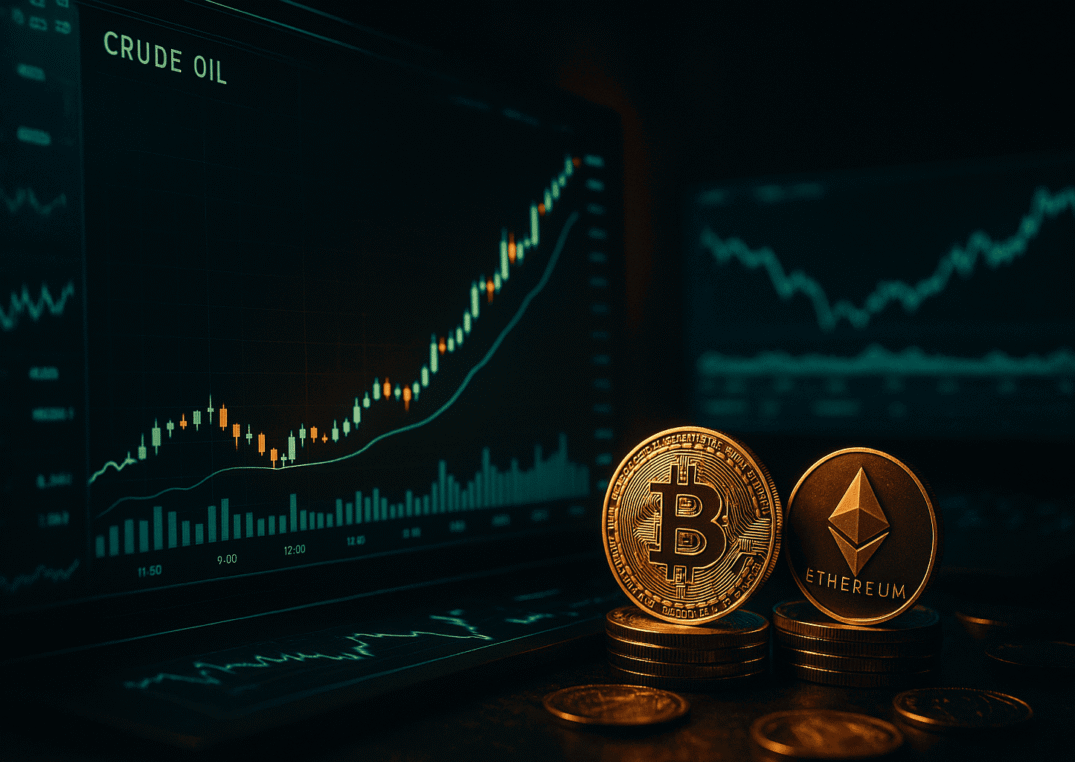
West Texas Intermediate crude futures advancing to nearly $80 from $67 since the month began marks a sharp acceleration in an input cost closely watched for its pass-through to price pressures. That swing has stoked fresh concerns about inflation just as markets await the next official read on consumer prices. The immediate sequence is clear: CPI lands first, then attention shifts to policy commentary. The oil impulse complicates interpretation because it arrives alongside expectations for softer inflation data.
Economists surveyed by Bloomberg anticipate headline CPI below 4% year over year. The June report is expected to show the first declines in both headline and core inflation since January, following May’s 4.2% and 2.9%, respectively. Yet the source of tension for traders is timing: even if the CPI print aligns with forecasts, the move in crude raises the risk that the figures are judged backward-looking, with markets quickly refocusing on prospective pressures.
Key Levels and Technical Context
The oil market is anchoring the macro discussion with two reference points: nearly $80 a barrel on the upside versus $67 at the start of the month. That range frames the month’s re-acceleration in energy costs. On the inflation side, traders will benchmark Tuesday’s CPI against economists’ expectation for sub-4% headline inflation, and against May’s outcomes of 4.2% and 2.9% for headline and core. The interplay between those markers—energy’s climb and anticipated CPI moderation—sets the near-term technical backdrop for macro-sensitive crypto positioning.
In practice, the crypto market often maps its directional bias to incoming inflation data and resulting policy expectations. Within that framework, an anticipated downtick in CPI juxtaposed with higher oil invites a nuanced read: a soft print could validate the view that inflation is easing, but the energy rebound argues for vigilance regarding subsequent readings.
Trading Activity and Liquidity
The trading day’s structure centers on the CPI release at 8:30 a.m. ET, followed by focus on Mr. Warsh’s appearance on Capitol Hill. That cadence directs liquidity and risk management around scheduled macro catalysts. The near-$80 oil context increases the perceived stakes of the data: if inflation appears more persistent than expected, it could amplify concerns about the Fed’s path forward; if it does not, the market still confronts the possibility that the oil impulse shifts the narrative beyond the June snapshot.
Given the Fed chair’s preference for limited forward guidance, investors will be watching closely for any signals on rates and inflation in the day’s testimony. That dynamic typically channels attention to remarks that clarify tolerance for inflation variability and the balance between holding steady and tightening.
On-Chain and Derivatives Data
The source material does not include on-chain or crypto-derivatives metrics. This report therefore focuses strictly on the macro inputs cited: the oil move toward $80 from $67, the anticipated CPI trajectory, and the upcoming policy commentary. Traders commonly integrate such macro readings with their own on-chain and derivatives dashboards when calibrating risk, but no such figures are provided in the source.
Why This Matters for Traders
The sequencing of events and the specific context matter. First, headline CPI is expected to slip below 4%, with both headline and core anticipated to decline for the first time since January (relative to May’s 4.2% and 2.9%). For a market attuned to inflation’s direction, that would usually be supportive of risk-taking. Second, the oil rally to nearly $80 from $67 at the start of the month reintroduces forward inflation risk that may not be captured fully in June’s data. Even if the CPI figures meet expectations, the prospect that they are backward-looking complicates conviction.
Third, attention then pivots to policy communication. Investors will look to Mr. Warsh’s testimony for rate and inflation signals, with specific interest in whether messaging underscores patience or a readiness to react if inflation persistence re-emerges. According to analysts at ING, he could “if he chooses, emphasize the tameness of inflation expectations.” They also observed that Mr. Warsh “has enough ammunition here to ride the rate hike risk and instead hold pat. Even if he comes under pressure to hike, the richness attached to the 5yr part of the curve tells us that any hike (if delivered) is likely to be subsequently reversed, with the prospect still for bigger cuts than hikes.”
Broader Market Context
Macro-sensitive assets, including crypto, often key off the interplay between realized inflation and policy reaction functions. The day’s setup features a potentially softer inflation print against a near-term rise in an input cost that can feed future inflation gauges. That tension channels focus to the policymaker commentary that follows. Given the Fed chair’s preference for limited forward guidance, rates messaging tends to avoid pre-committing, which can amplify market sensitivity to small shifts in emphasis—especially around inflation expectations, the balance of risks, and the threshold for action.
The ING perspective that the “richness” in the 5-year part of the curve suggests any prospective hike could be reversed, with larger cuts than hikes still on the table, frames how traders may think about the distribution of outcomes. For crypto market participants calibrating exposure around macro catalysts, this serves as a reminder that policy paths can be conditional and that markets may treat hawkish signals as contingent rather than durable if the growth-inflation mix evolves.
Outlook
Into the CPI release at 8:30 a.m. ET, the market will test two ideas arising from the source context. First, do the June figures confirm a downshift in inflation—with headline below 4% and both headline and core declining for the first time since January, relative to May’s 4.2% and 2.9%—or does the data hint at greater persistence? Second, how does the oil upswing toward $80 from $67 at the month’s start color the interpretation of any moderation, given the risk that today’s reading is judged backward-looking?
Post-release, the focus shifts to Capitol Hill. With investors alert to the limits of forward guidance, incremental signals from Mr. Warsh’s testimony on rates and inflation may set the tone. ING’s view that he could emphasize the tameness of inflation expectations, and that he has room to “ride the rate hike risk and instead hold pat,” provides a reference for how policy risk might be framed. They further note that, even if pressure to hike emerges, the 5-year curve’s richness points to any hike likely being reversed, with scope for “bigger cuts than hikes.”
For crypto traders, that chain of events—oil’s move, CPI’s print, and policy color—defines the near-term macro backdrop. The source material stops short of prescribing market direction; it underscores the catalysts and the interpretive lens. Positioning and risk management will likely revolve around how closely the day’s developments align with the expectations set out here and how the evolving oil dynamic influences the next rounds of inflation data.
