


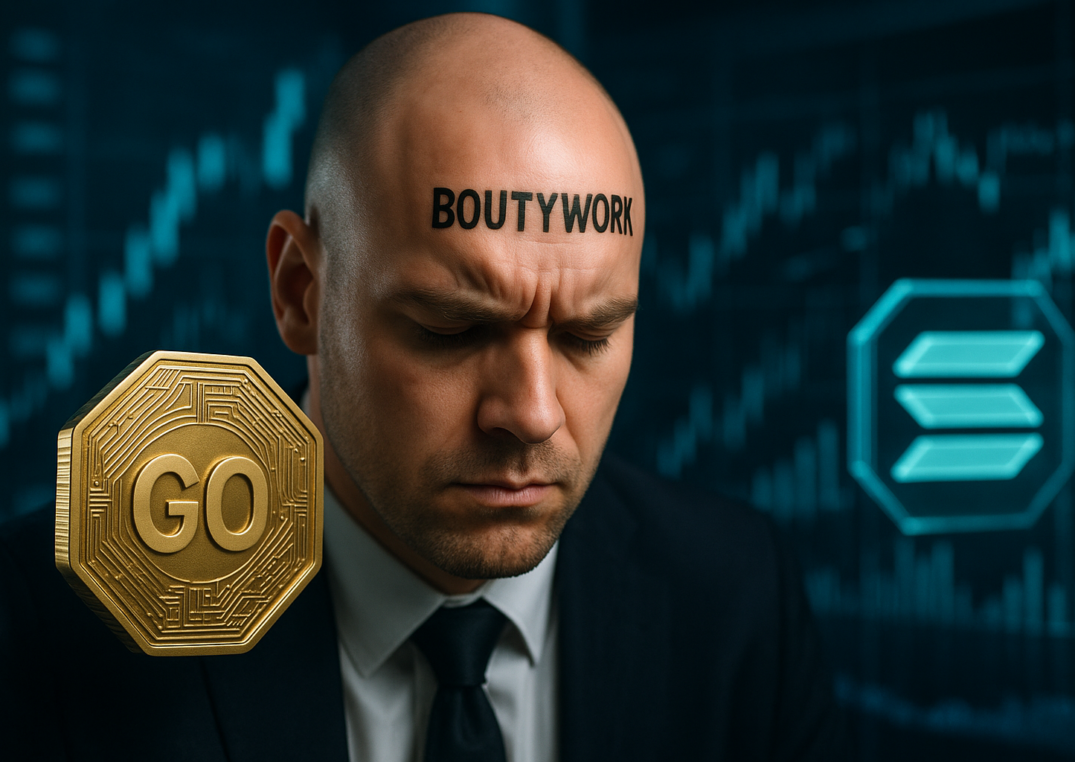
Pump.fun Faces Backlash After Forehead‑Tattoo Bounty Typo as Solana Traders Mint ‘BOUTYWORK’
Meta Description: Pump.fun’s GO marketplace sparks dispute after a 40 SOL forehead‑tattoo bounty typo; Solana traders launch BOUTYWORK token, netting the participant about $17.5k.
Key Takeaways
- Pump.fun opened its GO bounty marketplace on June 4, 2026. A 40 SOL offer to tattoo “$boutywork” on a forehead quickly turned contentious over a spelling error.
- Arivu, from Tamil Nadu, India, tattooed the ticker exactly as written and posted video proof on June 6. The payout stalled amid debate that the intended ticker included an “n.”
- Solana traders launched a BOUTYWORK token using Arivu’s image, sending the coin to a roughly $373,000 market cap within hours. Creator fees routed to him were around $15,000, with estimates near $17,500 in total, while the unpaid bounty was worth about $2,585 at $64.62 per SOL. The original payout remains pending review by Pump.fun moderators.
Pump.fun’s newly launched “GO” marketplace, a venue where users post crypto bounties for almost any task, is under scrutiny after a 40 SOL reward to tattoo “$boutywork” on a forehead devolved into a dispute over a simple typo. The incident matters because it highlights early moderation challenges for GO—launched on June 4, 2026—just as Pump.fun courts a broader audience, pivots messaging toward utility, and navigates questions around its valuation and a high‑profile token buyback campaign. In a twist emblematic of Solana’s fast‑moving meme economy, traders created a token named BOUTYWORK in response, delivering significantly more to the participant than the troubled original bounty.
Market Movement
The flashpoint came from a straightforward, if extreme, listing: 40 SOL to permanently tattoo the ticker “$boutywork” on a forehead. Arivu, a man from Tamil Nadu, accepted the challenge and documented the process at a local shop, posting video proof with visible aftercare on June 6. Debate erupted almost immediately over whether the original poster had intended to include an “n” in the ticker—“$Bountywork”—with some observers arguing the misspelling invalidated the claim. That dispute delayed the payout.
As the argument unfolded, Solana traders did what on‑chain communities often do in moments of controversy: they minted a token to crystallize the narrative. A BOUTYWORK coin—spelled to match the tattoo—was launched on Pump.fun, using Arivu’s selfie as its logo. Within hours, the coin reached a market capitalization of roughly $373,000, a sizable print for a meme token born from a clerical error and a viral video. The token’s creator fees routed to Arivu were estimated around $15,000, with an overall take near $17,500 as activity built, compared with the roughly $2,585 value of the original 40 SOL bounty using a reference price of $64.62 per SOL.
The pace and scale of the move underscored how quickly value can accrete around symbols and stories on Solana, particularly when the catalyst comes with undeniable proof of work—in this case, a permanent tattoo echoing the original text. The on‑chain pivot effectively converted a disputed, modest payout into a larger, market‑driven distribution backed by participants who found the storyline compelling.
Trading Activity
BOUTYWORK’s rapid price discovery mirrors a familiar rhythm in Solana’s meme economy. A novel prompt or viral asset catalyzes attention; early traders bootstrap liquidity; momentum traders chase; and then a wider set of participants decides whether the meme has legs. Here, the asset’s narrative was unusually strong: a verifiable, irreversible act tied directly to a single, misspelled string that anyone could see on a forehead. That made the token’s ticker unambiguous and the marketing instantaneous.
Creator fees channeled to Arivu provided an immediate revenue stream that, at least initially, far exceeded the bounty’s dollar value. While fee structures and distribution paths can vary by token and platform settings, the takeaway in this case is straightforward: direct on‑chain monetization of attention can overwhelm off‑chain disputes when communities align around a meme. Traders effectively converted a controversy about technical compliance with bounty rules into a live, tradable instrument that compensated the participant at market speed.
Volume and liquidity details were not disclosed in the source material, but the market cap figure indicates sufficient early demand to support rapid repricing in the first hours after launch. Those conditions are consistent with the broader pattern of Solana meme trading in 2026, where attention, speed, and narrative often dominate short‑term flows.
Investor Sentiment
The reaction split into two camps. One camp emphasized strict interpretation of the bounty’s exact text—“$boutywork”—which Arivu followed to the letter, as shown in his post and accompanying footage. The other camp suggested the bounty’s spirit pointed to “$Bountywork,” arguing that a typographical error should not determine eligibility for a reward. That split became a referendum on how Pump.fun’s GO marketplace should adjudicate assignments with ambiguous or flawed instructions.
For traders, the ambiguity did not stall risk appetite. The launch of BOUTYWORK served two functions at once: it signaled support for the participant and created a speculative instrument tied to a trending story. The token’s design—a direct lift from the misspelling—also functioned as a protest and a punchline, both potent fuel in meme markets. Early buyers appeared to be rewarding the act itself while front‑running the possibility that broader social media attention could pull in incremental demand.
If the moderators ultimately deny the original bounty because of the typo, investors who rallied around BOUTYWORK may frame the token’s early gains as a community‑driven remedy. If the payout is approved, the token still stands as a record of how quickly Solana speculators can repackage a narrative into tradable form. Either outcome reinforces the idea that market participants are willing to subsidize—or monetize—viral on‑chain lore in real time.
Broader Market Context
The episode arrives during a period of heightened focus on Pump.fun’s trajectory. The GO marketplace began on June 4, 2026, with a remit broad enough to include challenges that many traditional platforms would screen out. The immediate backlash to extreme listings put the spotlight on content moderation, safeguards, and the boundary between entertainment and exploitation. At the same time, Pump.fun has promoted a pivot toward “utility tokens,” invited scrutiny of its native token valuation, and announced a buyback plan reported at $350 million. All of these threads set the stage for heavier expectations around governance and risk controls.
Meme coins and bounty markets overlap in their reliance on attention. Both reward speed and spectacle, and both can impose real‑world costs on participants. In this case, the cost was literal and permanent, etched onto a forehead. That tangibility likely enhanced the meme’s potency: unlike many stunts, the proof was embedded in a person, not just in an on‑chain hash or a screen recording. The community’s willingness to rally capital around that proof demonstrates how narrative density—clear protagonist, visible sacrifice, tidy ticker—can catalyze trading behavior on Solana within hours.
For observers tracking market health, these dynamics are double‑edged. They show that Solana’s retail rails remain efficient for rapid token creation and distribution. They also stress‑test the social and ethical frameworks governing new products like GO, where real‑world tasks blur into staking mechanisms for attention. The unresolved question is whether platforms can design moderation guardrails that preserve the spontaneity traders prize without enabling assignments that invite harm, misinterpretation, or post‑hoc disputes.
Industry Impact
Moderation outcomes in early, high‑visibility cases often set the tone for new marketplaces. A decision by Pump.fun’s team on whether the typo voids or validates the 40 SOL bounty could form a template for future rulings: Does literal compliance with a prompt outweigh intent if the text contains an error? Are posters responsible for accuracy, or do participants bear the risk of misprints? Will there be formal appeal processes or escrow rules to reduce ambiguity before a task is completed?
Clearer structures—such as locked prompts, standardized dispute windows, or explicit “as‑written” versus “as‑intended” categories—could lower friction and reduce the probability of edge‑case blowups. That said, too much structure might dilute the freewheeling quality that made Pump.fun popular with meme traders in the first place. The platform’s balancing act is to make GO safe and predictable enough to scale without flattening the creativity and virality that drive its order flow.
The tokenization of the typo also hints at a broader reality: on public blockchains, communities can route around friction by issuing a token that crowds in sentiment and capital. That flexibility is a competitive advantage for Solana’s retail culture. It is also a governance challenge. If off‑chain rules and on‑chain workarounds clash regularly, platforms will face a steady stream of hard edge cases—particularly when tasks, like a tattoo, carry irreversible consequences.
What This Means for Crypto Markets
Three implications stand out from the BOUTYWORK episode:
First, meme market reflexes remain strong. Converting a controversy into a token with a six‑figure market cap in hours demonstrates how quickly retail liquidity mobilizes around social signals, especially on Solana. That responsiveness favors traders who track social channels closely and can price narratives as they form, not after they stabilize.
Second, creator monetization is evolving beyond straightforward bounties. In this case, the most material compensation for the participant did not come from the original 40 SOL offer but from downstream fees and support tied to a community‑issued token. That structure blurs the line between compensation, patronage, and speculation. As more creators recognize that attention can be tokenized directly, bounties may increasingly serve as catalysts rather than endpoints.
Third, platform governance will influence order flow. If Pump.fun establishes a predictable policy for textual errors and disputed submissions, it could reduce headline risk while encouraging higher‑value, better‑specified tasks on GO. If policy remains ad hoc, traders may keep relying on tokenized “fixes” to adjudicate disputes in the market, introducing more volatility but also more opportunity for fast movers.
For investors, these patterns argue for a disciplined framework when trading story‑driven assets: identify the catalyst; size risk based on liquidity and lifecycle; monitor social velocity; and pre‑define exit rules in case the narrative cools. Even where numbers are small in absolute terms, the percentage swings can be extreme, and the half‑life of attention can be short.
Conclusion
A misspelled five‑letter string on a forehead became a live case study in how Solana’s meme economy collides with new bounty mechanics. GO’s June 4 launch created a venue for cash‑for‑tasks at crypto speed; within days, a 40 SOL offer turned into a test of moderation, intent, and community norms. Arivu followed the text precisely and posted time‑stamped proof on June 6. While the payout stalled amid arguments over an omitted “n,” traders minted a BOUTYWORK token that surged to a roughly $373,000 market cap within hours and directed an estimated five‑figure sum to the participant—far above the original reward’s dollar value using a $64.62 reference price for SOL.
The final call on the bounty now rests with Pump.fun’s moderators. Their decision will likely guide how GO handles typos, ambiguity, and edge‑case submissions. Whatever the outcome, the market has already issued its own verdict on the value of a viral, verifiable act: in Solana’s attention markets, a clear narrative can become capital almost instantly, even when it’s spelled wrong.
