


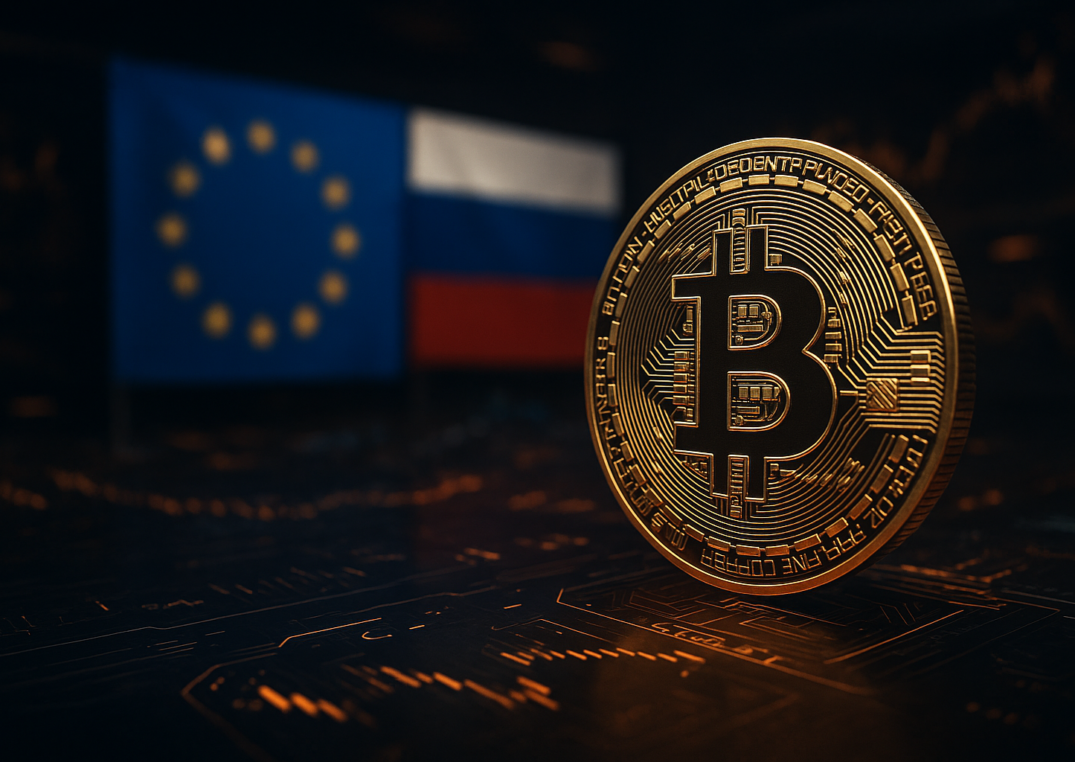
The European Union has unveiled its biggest sanctions package in two years, placing the crypto market at the center of new restrictions with a total sectoral ban on providers and platforms established in Russia that facilitate the transfer or exchange of digital assets. Announced on April 23, the measures are described by the bloc as far‑reaching and restrictive, and extend to prohibitions on Russia’s central bank digital currency as well as its ruble‑pegged RUBx stablecoin, alongside a bar on any EU support for developing the digital ruble.
Market Movement
The new prohibitions significantly tighten the operating environment for crypto activity linked to Russia and Belarus, particularly where EU counterparties and infrastructure are involved. By imposing a total sectoral ban on providers and platforms established in Russia, the package seeks to constrain flows that move through centralized exchanges and decentralized finance venues connected to those jurisdictions. The approach is designed to block transfer and exchange pathways that have been used for international transactions, limiting access points to liquidity and settlement channels that intersect with the European market.
These measures arrive with an explicit emphasis on the role of cryptocurrencies in cross‑border transactions. The EU stated that Russia is increasingly reliant on digital assets for payments beyond its borders, framing the crypto‑specific prohibitions as essential to closing off avenues that could otherwise facilitate the movement of value. In practical terms for market participants, the new restrictions draw hard lines around counterparties and services tied to Russia and Belarus, reshaping the set of venues, asset pairs, and settlement rails that EU persons can interact with.
Key Drivers
The sanctions architecture reflects a focus on cutting off systemic connectivity. The EU’s ban on providers and platforms established in Russia targets the core intermediaries that enable on‑ and off‑ramps into the wider crypto economy. The additional prohibition on the digital ruble and RUBx seeks to prevent any central bank or state‑linked digital asset from serving as a bridge to financial services that touch EU entities. Together, these steps emphasize a comprehensive approach: disable the platforms, block the instruments, and restrict the points of regulatory engagement that could legitimize or sustain flows.
According to a report from blockchain intelligence firm Chainalysis, the package also encompasses actions outside traditional banking channels. Measures have been taken against 20 Russian banks and four third‑country financial institutions and entities that connect to the Russian System for Transfer of Financial Messages (SPFS), Russia’s banking messaging network. While these steps address fiat infrastructure, they have direct relevance for crypto markets by limiting the auxiliary rails that can support crypto‑fiat intermediation tied to sanctioned actors.
Investor Reaction
The text of the measures clarifies the position for market participants within the EU. People from the EU are no longer allowed to transact with cryptocurrency service providers (CASPs) and decentralized finance platforms from Russia and Belarus. They are also barred from providing Markets in Crypto‑Assets Regulation (MiCA) services to Belarusian individuals and entities. In addition, the EU states that netting transactions with Russian agents are now forbidden, an effort aimed at preventing indirect circumvention via offsetting arrangements.
In aggregate, these restrictions set explicit boundaries on counterparties and service relationships. For EU‑based market actors, the rules define which platforms must be excluded from trading and settlement workflows, which client segments are off‑limits for service provision, and which transaction structures—such as netting—cannot be used to compress or obscure exposure. The parameters are intended to minimize ambiguity around what constitutes prohibited crypto involvement linked to Russia and Belarus.
Broader Impact
Chainalysis notes that the EU has also imposed sanctions on TengriCoin, a Kyrgyz crypto exchange operating as Meer.kg, where significant amounts of the government‑backed stablecoin A7A5 are traded. This measure follows years of escalating enforcement actions targeting the broader Garantex–Grinex–A7A5 ecosystem tracked by the firm. As documented by Chainalysis, A7A5 has processed $119.7 billion to date and functions as a purpose‑built settlement rail designed to connect sanctioned Russian businesses to the global financial system. In its 2026 Crypto Crime Report, Chainalysis reported that this figure exceeded $93.3 billion in less than a year, underscoring the scale of flows that investigators have associated with this network.
By acting against a venue where A7A5 is actively traded, the EU’s package attempts to curtail activity around a stablecoin that blockchain analysts say has become integral to settlement among sanctioned entities. Limiting such rails seeks to reduce the liquidity and transfer options available to networks that rely on purpose‑built tokens to bridge into broader markets. In the context of the EU’s sectoral ban on Russian‑established providers and platforms, the action against TengriCoin/Meer.kg complements the wider strategy of isolating access points that could facilitate movement of funds.
Chainalysis characterizes the cumulative effect of the package as creating an ecosystem‑wide crypto restriction on Russia and Belarus. In practice, this characterization reflects overlapping prohibitions: EU persons cannot transact with Russian and Belarusian CASPs and DeFi platforms; EU support for the digital ruble is prohibited; the RUBx stablecoin is banned; and sanctions extend to financial institutions connected to SPFS, as well as to the trading venue linked to A7A5. Each component targets a facet of market infrastructure or liquidity that, in combination, constrains access to the European financial system.
The sanctions text also references countries in connection with financial services, trade flows, or intermediary activity, including Kyrgyzstan, China, the United Arab Emirates, Uzbekistan, Kazakhstan, and Belarus. By naming these jurisdictions within the package, the EU signals attention to cross‑border pathways that may intersect with sanctioned entities, adding geographic context to the measures aimed at channels that could facilitate indirect access to markets.
Within this framework, the EU’s move positions crypto restrictions alongside traditional financial sanctions to form a unified stance. The measures against banks and SPFS‑linked institutions address messaging and payment infrastructure, while the crypto‑specific prohibitions aim at digital asset venues, instruments, and services. The intent is to reduce the avenues through which international transactions can be routed, whether through fiat networks or through crypto ecosystems that touch EU participants.
The overall package underscores the EU’s assessment that crypto has become a meaningful component of international settlement for sanctioned Russian actors. By targeting providers, platforms, CBDCs, stablecoins, and specific trading venues in tandem, the bloc establishes a comprehensive set of constraints. For crypto markets that intersect with EU jurisdictions, the immediate outcome is a clarified compliance perimeter around Russian and Belarusian entities and services, backed by explicit prohibitions on transacting, servicing, and netting. In scope and construction, the measures represent the EU’s most extensive crypto‑focused sanctions effort in two years, aimed at reshaping how and where digital asset flows linked to Russia can interface with the European financial system.
