
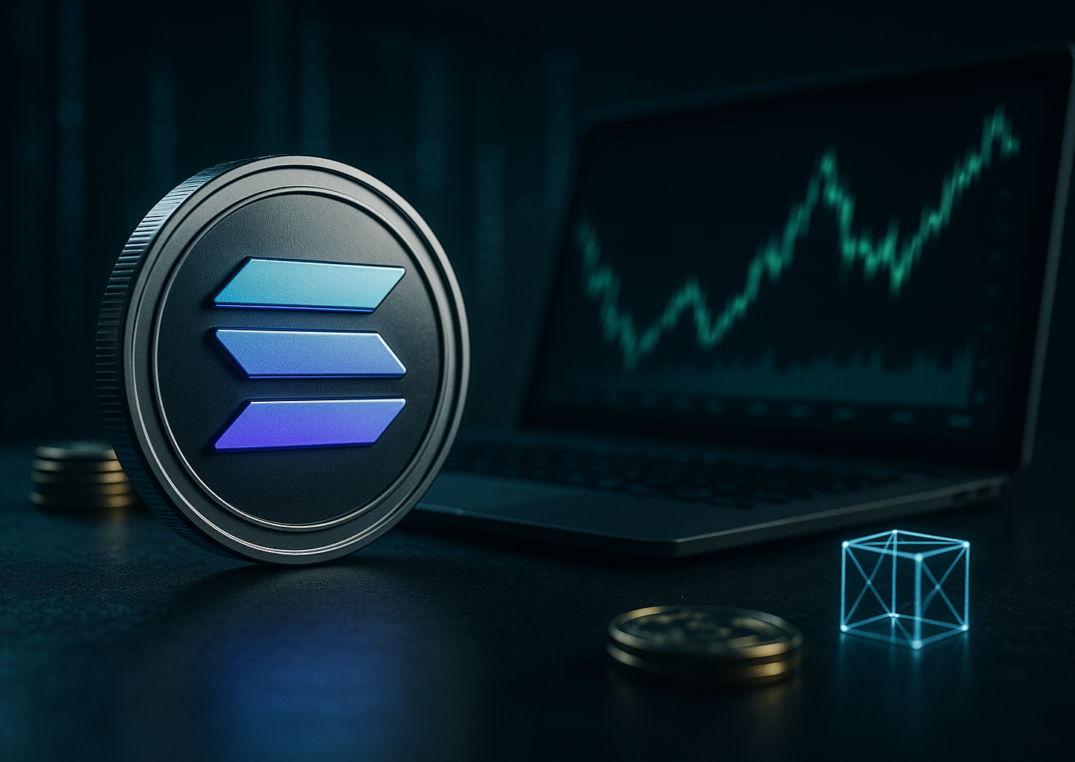
Solana’s core validator clients Anza and Firedancer have each shipped test implementations of Falcon-512, a post-quantum digital signature scheme whose compact signatures stand out among algorithms approved by the US National Institute of Standards and Technology—an upgrade positioned squarely at the intersection of network performance and long-term security, with SOLUSD now trading at $83,73 according to TradingView.
Market Movement
The release lands as SOL changes hands at $83,73, a level that keeps attention on whether security-focused upgrades can align with the throughput and latency profile that traders expect from Solana. For a high-throughput blockchain, signature size and verification overhead can ripple through to fees, block composition, and validator resource demands. The test deployments are framed to preserve those market-critical attributes, aiming to reassure participants that post-quantum readiness does not compromise execution speed or network capacity.
Officials involved in the work said the migration path is manageable, a cutover could occur rapidly if needed, and that the network’s performance characteristics are not expected to take a meaningful hit. For market participants tuned to throughput and confirmation times, this guidance is designed to limit uncertainty that can weigh on trading behavior during protocol-level changes. The emphasis on maintaining speed and minimizing overhead directly addresses a core concern in periods when new cryptography is introduced.
Key Drivers
At the center of the decision is Falcon-512’s signature size. Post-quantum schemes are often criticized for producing bulky signatures that can bloat blocks, tax bandwidth, and increase storage requirements across validators. Those issues are especially consequential for Solana, where transaction density and low-latency block production define the user and trader experience. By contrast, Falcon-512 produces notably small signatures among NIST-approved options, a trait that helps align future security safeguards with existing performance goals.
Both Anza and Firedancer say they reached their choice independently after researching quantum readiness and converged on the same conclusion: preparing for a post-quantum environment is necessary, and Falcon is the right fit for Solana’s design objectives. The first test versions have been committed to the clients’ GitHub repositories; activity from Anza’s account shows work on Falcon dating back to at least January 27, 2026, underscoring that this is not a last-minute pivot but part of a sustained engineering effort.
The integration is architected to remain dormant unless and until conditions warrant activation. In practice, that means the functionality can stay idle in the background and be switched on should “Q-Day” arrive—the point at which quantum computers are deemed powerful enough to jeopardize today’s public-key cryptography. This dormant-by-default approach seeks to minimize disruption while putting the tools in place for a rapid response if the threat landscape shifts.
Why Signature Size Matters
Solana’s design prioritizes high throughput, which makes cryptographic overhead more than a theoretical concern. Larger signatures inflate transaction payloads, elevate network bandwidth requirements, and swell ledger storage, creating potential friction for validators and infrastructure providers. Those costs can gradually influence fee dynamics and throughput ceilings—variables watched closely by active traders and liquidity providers.
Firedancer’s backer, Jump Crypto, highlighted that Falcon was selected precisely to mitigate that risk. Signing occurs offchain, and verification complexity is described as straightforward to implement. If verification remains light and signatures remain compact, blocks can carry more transactions without material trade-offs, which supports the network characteristics that underpin active trading strategies.
Implementation Details and Readiness
Beyond signature size, teams emphasized operational practicality. The stated view is that migration work is within reach and the switch, if triggered, could be executed quickly. That framing matters to market participants who prize clarity around potential downtime or performance anomalies. An orderly, well-scoped transition path reduces the prospect of unexpected latency spikes or validator churn that can unsettle trading conditions.
This initiative sits at a different layer from prior post-quantum efforts around Solana. Blueshift’s Winternitz Vault, introduced in January 2025, was designed as an optional user-level enhancement rather than a protocol-wide shift. By contrast, the Anza and Firedancer work targets validator clients that form the backbone of block production and transaction verification, expanding the conversation from opt-in user tools to network-level readiness.
Investor Reaction
The introduction of test implementations typically prompts close monitoring from market participants who track validator client diversity, code readiness, and operational risk. The fact that both widely used clients are moving in lockstep toward the same scheme reduces the chance of fragmentation across the validator set, a scenario that could otherwise create interpretive or operational asymmetries. With initial versions already on GitHub and the functionality designed to remain inactive until needed, traders and infrastructure operators can evaluate progress without immediate changes to transaction handling.
Importantly, the communication that performance should remain stable is likely to be read as an attempt to preserve the trading environment that Solana’s user base expects. While the upgrade is structured for the long term, clarity today on throughput and latency supports day-to-day market functioning at a time when SOLUSD is quoted at $83,73.
Broader Impact
The timing intersects with a broader debate about quantum timelines. Reports indicate rising urgency around quantum threats, with Google and researchers at the California Institute of Technology suggesting that functional systems may arrive sooner than many anticipated and could need less computational power to undermine current encryption than earlier models implied. Google went further, asserting that quantum machines might break Bitcoin’s cryptography within 10 minutes. Those claims, while attention-grabbing, sit alongside skepticism from industry and academia. Blockstream CEO Adam Back has characterized current quantum computers as laboratory experiments and argued that a genuine threat is decades away. Scott Aaronson, a leading voice in quantum computing theory, generally agrees that today’s machines are far from the scale required to compromise systems like Bitcoin, even as he acknowledges the importance of longer-term preparation.
For Solana’s market, the upshot is that infrastructure planning is advancing without presupposing an imminent disruption. By integrating Falcon-512 in a way that can be activated if necessary and idle otherwise, developers are attempting to balance near-term performance with future-proofing. That balance is critical for a chain whose competitive edge is tied to execution speed and capacity, while price watchers note SOLUSD at $83,73.
As the test implementations mature, attention is likely to remain on verification performance, validator uptake, and any operational guidance from Anza and Firedancer. The stated objective is clear: preserve the trading experience that has defined Solana’s appeal while putting post-quantum safeguards within reach should Q-Day move from hypothetical to actionable.