


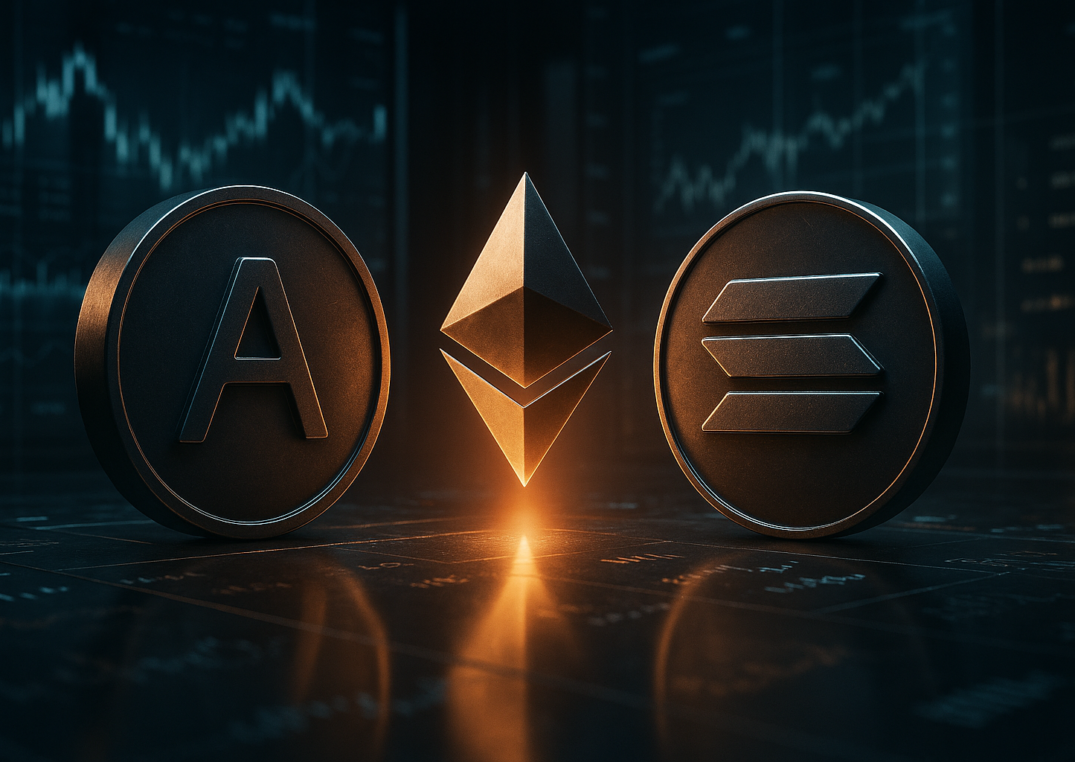
Aave [AAVE] has expanded to Solana via Sunrise DeFi, routing Ethereum-backed liquidity onto the high-throughput network to pursue faster execution and lower fees—an increasingly prominent theme in crypto markets as participants seek higher capital efficiency and quicker trading loops.
Market Movement
The immediate effect of the move is visible in how liquidity is being repositioned across chains rather than created anew. While Aave’s total value locked (TVL) stands at $14.7 billion, more than $12 billion of that remains anchored on Ethereum [ETH], underscoring Ethereum’s central role in Aave’s risk and liquidity profile even as capital begins to bridge. As assets shift, Solana’s [SOL] $5.6 billion DeFi base is beginning to absorb a share of these flows, reflecting a rotation that aligns with market demand for faster settlement and cheaper execution.
Stablecoins provide an important foundation for this activity. Solana’s $15.35 billion stablecoin pool supports the chain’s high transaction throughput, creating conditions that can accommodate active trading and frequent repositioning. In periods when rotation intensifies, this backdrop has at times coincided with weekly decentralized exchange (DEX) volumes on Solana surpassing those on Ethereum, highlighting how liquidity shifts can temporarily remake the trading landscape even when the underlying demand is largely migratory rather than additive.
However, the current pattern of inflows is primarily linked to portfolio rebalancing across ecosystems, not to a broad influx of new capital. That distinction matters for price discovery and depth: when TVL growth echoes migration rather than new demand, market-wide liquidity can appear thicker in headline terms while remaining thinly distributed at the venue level, increasing the chance of uneven execution conditions.
Key Drivers
Aave’s deployment takes direct aim at Solana’s technical advantages for transaction-heavy strategies. The network’s architecture sustains throughput in the thousands of transactions per second, with peaks near 65,000, while maintaining block times around 400 milliseconds. Typical fees near $0.00025 enhance the cost differential compared with Ethereum during periods of congestion, allowing frequent supply-and-borrow interactions to settle at a fraction of legacy costs.
Those conditions can tighten the “yield loop” that underpins on-chain money markets. As liquidity migrates, borrowing and lending cycles can compress, enabling users to supply collateral, initiate loans, repay, and redeploy collateral more rapidly. In principle, this increases pool utilization and turns previously idle collateral into more active yield generation. The immediate market impact is not simply larger balances, but faster balance turnover, deeper participation in liquidity markets, and a higher cadence of position adjustments.
Still, the same factors that attract capital toward speed can introduce fragmentation risks. When the rise in TVL closely tracks cross-chain rotation rather than incremental onboarding, liquidity may be spread thinner across venues and assets. That can leave markets more sensitive to shifts in borrow demand, with realized depth and slippage hinging on whether traders and lenders continue to cycle funds at a sustained pace.
Investor Reaction
For market participants, the central question is whether borrowing activity on Aave’s Solana deployment will validate the early liquidity migration. While liquidity often arrives first, the durability of those positions depends on borrower appetite. Rising loan originations and an expanding borrower base would push utilization higher across pools, reinforcing the rationale for maintaining or increasing allocations to Solana-based strategies.
Solana’s sub-second finality and near-zero fees are designed to support this behavior by shortening the interval between supply, borrow, repay, and redeploy steps. If participants can realize more frequent compounding without incurring prohibitive costs, the economics favor keeping funds in motion on-chain. In such an environment, traders can adjust collateral more often, arbitrageurs can rebalance quicker, and liquidity providers can reprice risk with finer granularity—all without erasing returns through transaction costs.
Stablecoin dynamics, led by USD Coin [USDC], are a key indicator of how much of this liquidity is truly deployable. Strong inbound stablecoin flows typically signal active positioning and a capacity for immediate participation in money markets and DEXs. By contrast, weaker flows imply a larger share of idle capital, increasing the odds that TVL headlines overstate the system’s ability to support borrowing demand at scale. If combined TVL rises in tandem with clear signs of usage, the case for durable expansion strengthens.
Broader Impact
The strategic through line is capital efficiency. Aave’s Solana expansion is a real-time test of whether speed and low fees can convert repositioned collateral into lasting activity. If borrowing and trading volumes expand alongside the shift in balances, liquidity can compound on itself: higher utilization anchors deeper books, tighter spreads improve execution, and more participants are drawn in by the improved conditions. In this scenario, the rotation does more than reshuffle balances—it enhances the structure of on-chain markets.
The alternative is a pattern in which liquidity relocates without a sustained uptick in demand. In that case, the market risks thinner depth across two ecosystems, with pockets of liquidity that look sizable in isolation but do not aggregate into broader resilience. The outcome would be uneven capital efficiency and a market more prone to episodic volume spikes—such as the weeks when Solana’s DEX activity outpaces Ethereum—without the corresponding growth in consistent borrowing and lending that underwrites stability.
For now, the implications are straightforward. Aave is channeling Ethereum-backed liquidity to Solana to capture faster execution and lower transaction costs. Ethereum remains the anchor for the majority of Aave’s TVL, even as Solana’s DeFi base and stablecoin reserves offer a platform capable of absorbing increased activity. The path from rotation to sustained growth runs through borrower demand: if loan originations and user participation deepen, the efficiency gains are likely to endure; if not, liquidity may continue to oscillate between chains, leaving both ecosystems to navigate the trade-offs of fragmentation.
In short, the expansion reflects an investor preference for throughput and affordability, while the next phase depends on whether borrowing demand and stablecoin flows can translate migratory capital into persistent market depth. Utilization will be the gauge to watch, as higher activity can consolidate liquidity, whereas weak demand would keep the focus on repositioning rather than genuine expansion.
